
Table of contents
- What a trucking seller’s market really means for carriers
- The data signals that carrier leverage is returning
- Why trucking rates winter often creates freight rate power first
- Non-domiciled CDL policy and why it can tighten capacity in 2026
- Dispatch Republic perspective: how to use carrier leverage without giving it back
- Frequently Asked Questions
The fastest way to tell whether the market is changing is not a headline. It’s the tone of the phone call.
When brokers start calling you back faster, when counteroffers stop getting ignored, and when the “take-it-or-leave-it” attitude softens, negotiation power is shifting. That is what a trucking seller’s market feels like on the ground.
From a dispatch desk, we see the same pattern every cycle: first the cheap freight gets harder to move, then the average freight gets repriced, and only later do long-term contract rates reset. If you want to benefit early, you need a plan that turns short bursts of freight rate power into steady profit—without burning your driver, your truck, or your safety score.
This article breaks down what a trucking seller’s market really means, what data signals suggest carrier leverage is returning, and how trucking rates winter often creates the first real tests of negotiating power in a trucking seller’s market. We’ll also cover a 2025–2026 factor dispatchers can no longer ignore: the non-domiciled CDL crackdown, California license cancellations, and the way brokers and insurers are changing how they approve carriers.
What a trucking seller’s market really means for carriers
In trucking, a trucking seller’s market means the carrier is the “seller” of capacity. In other words, you can pick your partners more often, pick your lanes more often, and enforce your terms more often. That is carrier leverage, and it is the foundation of freight rate power.
Carrier leverage shows up in small wins: you counter and the broker accepts. You ask for detention pay in writing and it’s included. You request an appointment adjustment and the broker works with you instead of threatening a claim. Those behaviors are freight rate power in practice.
A trucking seller’s market is not “rates up everywhere.” It’s lane-specific, equipment-specific, and week-specific. You can have lines of cheap freight in one region while another region is tight and hungry. That’s why it’s possible for trucking seller’s market conditions to appear in pockets even while the national story still feels mixed.
Here is the simplest definition from a dispatch perspective:
- If load supply is rising or stable while usable truck supply is shrinking, carrier leverage increases.
- If shippers and brokers need your truck more than you need their load, freight rate power increases, and freight rate power becomes easier to hold.
- If you can say “no” without starving, you are closer to a trucking seller’s market.
In 2026, the “usable truck supply” part is the key. The cycle is tightening not only because of demand. It’s tightening because of friction: winter disruptions, carrier exits, and policy-driven capacity pressure.
The data signals that carrier leverage is returning
Drivers don’t get paid by charts, but charts can help you spot the transition first. A trucking seller’s market builds quietly, then becomes obvious.
The Cass linehaul index turning upward
One of the clearer signs of carrier leverage turning is linehaul pricing (rates excluding fuel and accessorials).
Cass Information Systems reported that the truckload linehaul index rose month over month and was up year over year in January 2026, with weather challenging volumes. Cass also noted that warmer weather could cause trend reversion, but that spot rates were likely to accelerate at least into February, and that more shippers initiating one-year bids suggests movement in the cycle beyond weather.
That is a big deal for a trucking seller’s market discussion because it hints at something more durable than a one-week storm spike: contract conversations starting to shift. When contract loops start moving, carrier leverage becomes more stable.
Spot market rates showing winter strength
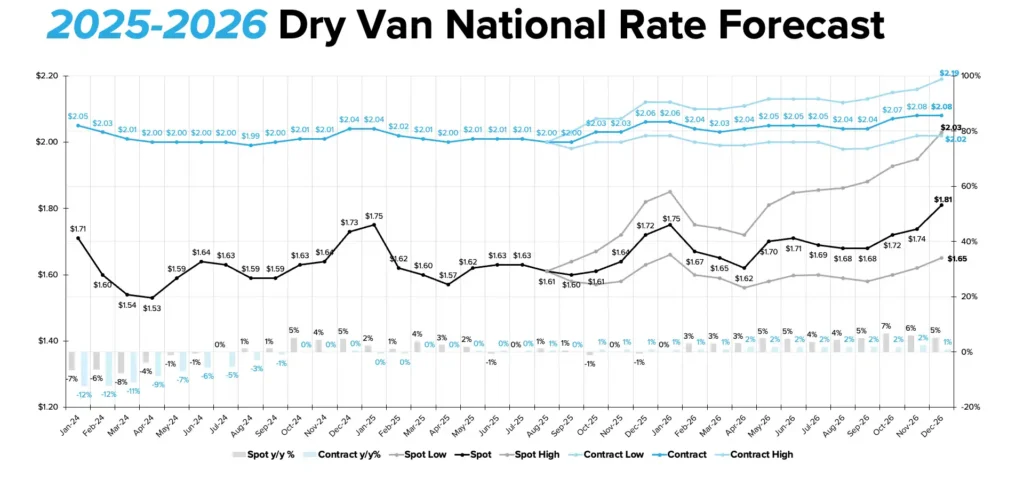
DAT Freight & Analytics’s January 2026 news release reported that spot market rates continued building on December gains even though January volumes declined after the holiday season. If spot market rates are rising while volumes are mixed, that is usually a capacity story—and it is often the earliest sign of a trucking seller’s market. DAT reported spot van around $2.32 per mile (up slightly), spot reefer around $2.81 (up more), and spot flatbed around $2.85 (up sharply).
This is trucking rates winter in action, and trucking rates winter is where a trucking seller’s market often shows up first. Winter does two things at once: it slows trucks down and it makes freight more time-sensitive. When both happen, the market pays for reliability. That is freight rate power.
It also explains why patience matters. Some winter gains are temporary. C.H. Robinson’s early February 2026 market update described the typical post-holiday spot decline, then winter storms that increased spot rates as capacity tightened, and also cautioned the uptick could be temporary.
In other words, trucking rates winter can create a short-term surge that looks like a trucking seller’s market. The smart move is to turn that window into freight rate power through better terms. Smart dispatchers treat that surge as a window to improve terms and rebuild margins—without assuming it lasts forever.
Tender rejection rates and “selectiveness”
Another reason dispatchers talk about carrier leverage is tender rejections. When carriers reject contract loads and those shipments move to the spot market, bargaining power shifts.
SONAR’s pricing power index commentary noted that national tender rejection rates hit a peak above recent years during the 2025 peak season and discussed elevated rejection.
You don’t need to know every index. The practical takeaway is this: when rejection rates stay elevated out of season, it often means either capacity is tighter or carriers are becoming more selective. Either way, carrier leverage increases, and spot market rates usually get more volatile.
What that means for your load board today
A trucking seller’s market is not a label. It’s a set of behaviors.
When carrier leverage improves, you will notice:
- Better offers show up faster in your strongest lanes.
- More loads include accessorial terms without a fight.
- Brokers chase you instead of the other way around.
- Your downtime between loads gets smaller if you keep the truck positioned well.
When those things happen, your job is to hold the line and not give back spot market rates gains too quickly. That is where patience matters, because patience is how you keep freight rate power once you gain it. It is easy to give away freight rate power by accepting the first rate, the first appointment, and the first set of terms. A trucking seller’s market rewards carriers who enforce standards.
For many fleets, combining systematic auto transport load dispatching with clear car hauler dispatch services results in more coordinated multi-stop routes and fewer idle miles.
Why trucking rates winter often creates freight rate power first
If you want to see the market’s true balance of power, look at trucking rates winter. Trucking rates winter is when dispatch mistakes get expensive.
Trucking rates winter is when capacity gets “converted” into usable capacity, and trucking rates winter is when carriers test their discipline. A truck can be available on paper but unusable in the network because:
- drivers must slow down,
- road closures force detours,
- customers reschedule loads,
- parking gets harder,
- HOS becomes tighter when delays stack.
That network friction is why trucking rates winter often creates freight rate power before the rest of the year does. This is also why trucking seller’s market conversations spike in January and February, then cool off in March.
Cass and DAT both noted winter weather affecting volume and pricing in late 2025 and early 2026, contributing to rate increases even as shipments or volumes softened.
One fresh example of trucking rates winter tightening the market came in February 2026 reporting. Reuters described refrigerated demand tied to Valentine’s flower shipments and an unusually cold winter, noting reefer spot rates around $2.81 per mile nationwide in January and sharp lane spikes out of Miami, while also linking tightening conditions to a shrinking labor pool and immigration enforcement pressure.
That story matters for a trucking seller’s market conversation because it highlights how quickly freight rate power can return in specialized segments when capacity is fragile. It also shows why patience matters: not every winter spike becomes a year-round trend, but carriers who use the premium window to improve terms and discipline often keep carrier leverage longer than carriers who simply run harder.
The key dispatcher lesson is that trucking rates winter is not “normal rates plus snow.” It is a different productivity environment. You run fewer safe miles per day. You lose more time at docks. You burn more fuel idling. So your minimum should rise.
That is rate optimization. In a stronger market, you don’t just ask for more because you want more. You ask for more because your real cost per day is higher. And when carrier leverage is improving, you can actually collect that premium.
Here’s a simple winter rule we use in dispatch during trucking rates winter:
If a load has high time risk, it must pay a winter premium, or it is not worth hauling.
That one rule protects profit per day and reduces the number of “busy but broke” weeks. It is a core part of using a trucking seller’s market correctly.
Why bad freight disappears first
In trucking rates winter, bad freight disappears first because drivers stop taking it. The cheap, high-risk freight gets reposted, then repriced, then it finally moves. That is freight rate power, and freight rate power is earned by saying no: the market is forced to pay for time and safety.
This is also where patience matters. In the early stage of a trucking seller’s market, the biggest advantage is the ability to refuse bad deals. If you keep taking bad deals out of habit, you do not benefit from carrier leverage.
Non-domiciled CDL policy and why it can tighten capacity in 2026
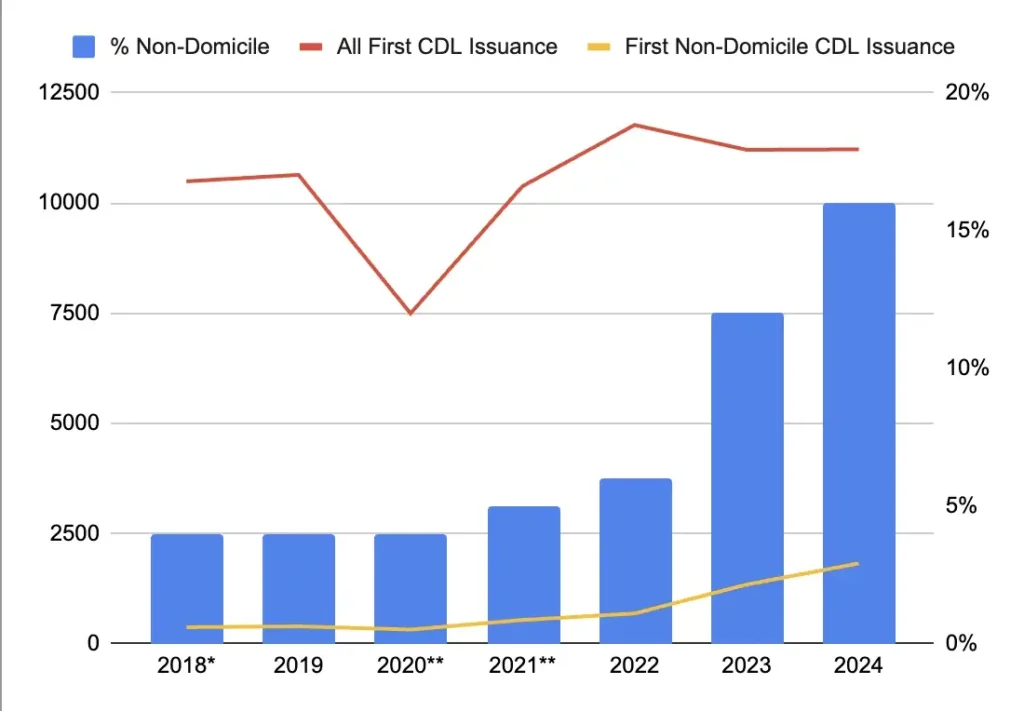
Dispatchers do not like surprises. In 2025–2026, the non-domiciled CDL crackdown became one of the biggest “surprise” factors affecting capacity and risk.
The reason it matters to a trucking seller’s market is mechanical, and trucking rates winter can amplify the effect: if fewer legally eligible drivers can operate, usable capacity falls. When usable capacity falls, carrier leverage rises and freight rate power rises—especially in lanes and regions where those drivers were active.
The 2026 final rule and its effective date
Federal Motor Carrier Safety Administration published FAQs about the 2026 final rule on non-domiciled CDLs and stated that states not in compliance on the March 16, 2026 effective date must pause non-domiciled credential issuance (including transfers) until compliant.
This is important because it turns licensing policy into immediate operational friction. If a state must pause issuance or renewal, that is reduced capacity in that state’s market.
FMCSA also posted previously that a court stay prevented the 2025 interim final rule from taking effect, and later commentary noted the final rule replaced the interim rule and set the effective timeline.
For carriers, the practical impact is not just whether a driver can renew. It’s also how brokers and insurers react to the risk.
California license cancellations and why they matter
California Department of Motor Vehicles announced in late 2025 that it extended the cancellation date of approximately 17,000 nondomiciled CDLs by 60 days while working with FMCSA, setting March 6, 2026 as the deadline.
California DMV also published guidance describing that it extended specific cancellation dates to March 6, 2026 (with certain exceptions for drivers domiciled in Mexico or Canada unless certain conditions apply).
This matters for trucking seller’s market conditions because California is not a small freight state. Any administrative shock affecting thousands of commercial drivers can tighten capacity in local markets. That increases carrier leverage in the exact lanes where capacity gets thinner.
Brokers screening carriers and insurers tightening underwriting
The “real-world” business effect is that brokers and insurers can change their rules before the government fully processes every case.
FreightWaves reported that Highway launched a feature that allows brokers to screen carriers based on whether the primary account owner holds a non-domiciled CDL, framing it as a response to regulatory scrutiny and liability concerns.
From the insurance side, Acrisure warned in November 2025 that underwriters may demand proof beyond a state-issued CDL and that carriers could face higher premiums, restricted markets, or higher deductibles when exposure is unclear.
This is exactly why some carriers are hearing from insurance agents that they may not want to write or renew coverage for fleets with this exposure. Even if the driver is legally authorized, underwriting can become more conservative when regulators and headlines focus on the issue.
So yes: forcing out non-domiciled drivers can boost rates for other trucks, because it reduces capacity and increases freight rate power. But it can also reduce your access to brokers and insurance if you are caught on the wrong side of compliance. In a trucking seller’s market, the winners are the carriers who can both negotiate hard and remain easy to onboard.
Dispatch Republic perspective: how to use carrier leverage without giving it back
A trucking seller’s market is not only about higher rates. It’s about smarter business.
When we dispatch trucks, our goal is to turn carrier leverage into profit per day, not just a big linehaul number—especially during trucking rates winter. That takes a system.
Even when hauling standard goods, careful planning matters: combining thorough dry van load management with solid dry van dispatch support can improve overall consistency.
Rate optimization starts before the load is booked
Rate optimization is not “asking for an extra $100.” Rate optimization is:
- choosing lanes that keep reload options strong,
- pricing time risk correctly,
- negotiating accessorials,
- keeping paperwork clean so cash flow stays stable.
In a trucking seller’s market, many carriers get excited and start grabbing everything. That is the fastest way to lose freight rate power. If you say yes to every load, you teach the market that you don’t actually have standards.
A simple rule for owner-operators:
If it doesn’t fit your lane plan, it doesn’t fit your business.
That is carrier leverage. It’s the confidence to refuse.
What we do as a truck dispatch service when trucking rates winter gets volatile
Trucking rates winter is where dispatch either helps you or hurts you, and it is where freight rate power must be protected. Here is how a truck dispatch service supports drivers during winter volatility. A truck dispatch service is valuable when the market is moving fast, because it protects your time and keeps your paperwork clean:
Re-booking loads fast. When a receiver pushes a delivery or a storm knocks out a route, “waiting to see what happens” is a profit leak. We re-book or reposition quickly so the truck isn’t sitting empty.
Adjusting routes and ETAs. We help plan safer routes, realistic ETAs, and we get appointment changes moving early. Early communication protects your service record and supports stronger carrier leverage in future negotiations.
Handling communications with brokers and shippers. Drivers shouldn’t spend their 10-hour break doing check calls. We handle updates so you can rest and drive safely.
Paperwork and compliance during delays. Winter creates more detention and layovers. If you don’t document, you don’t get paid. We help standardize the workflow for timestamps, signed documents, and fast billing so detention pay doesn’t get lost.
Advising on safe parking and stoppage. Sometimes the best decision is to park. In trucking rates winter, safe stoppage is part of rate optimization because it prevents violations, accidents, and costly service failures.
Two scenarios that show carrier leverage in real life
Scenario one: the “almost a seller’s market” mistake.
A solo owner-operator sees a strong offer and assumes it proves a trucking seller’s market is here. They accept without negotiating detention pay and without checking receiver history. The receiver takes six hours to unload, the driver misses the next pickup, and the “good rate” turns into a bad week. The fix is simple: use freight rate power to demand terms, not just higher base pay.
Scenario two: the “patient carrier” win.
A small fleet sees trucking rates winter tighten for a week. Instead of grabbing everything, they keep their lane discipline. They reject bad appointment freight, take clean loads that deliver into strong reload markets, and negotiate accessorials. They get fewer loads, but their profit per day increases. That is carrier leverage: you win by not giving your time away, and you keep freight rate power longer.
The patience rule
Here is why patience matters, especially in trucking rates winter: early seller’s market signals are often uneven and temporary.
Cass and C.H. Robinson both talked about weather-driven strength and the possibility of reversion when weather clears. That means you should enjoy the premium weeks—but you should not overextend your business assuming every week will look like that.
Patience matters because spot market rates can rise and fall faster than your monthly bills, and the carriers who survive the swings are the ones who keep standards even when the market is soft. That consistency is how you build relationships with brokers and shippers that pay cleanly. In a trucking seller’s market, those relationships pay even more.
A dispatcher checklist for holding carrier leverage in trucking rates winter
A trucking seller’s market is not just about one good load. It is about keeping freight rate power week after week.
Here is the short checklist we use to protect carrier leverage:
- During trucking rates winter, price time risk premium into every load with tight appointments.
- Get detention pay terms in writing, and document arrival and departure every time so you can collect.
- Keep the truck in reload markets so freight rate power turns into repeat business, not deadhead.
- Say no early: refusing bad freight is how carrier leverage stays real in a trucking seller’s market.
- Use your truck dispatch service to re-book fast when plans break, and use your truck dispatch service to manage check calls and billing, so trucking rates winter delays do not wipe out the week.
If you apply this consistently, a trucking seller’s market feels less like luck and more like a system: freight rate power rises, carrier leverage improves, and trucking rates winter becomes a season you can plan for instead of fear.
If you’re an owner-operator hauling specialized freight, don’t go it alone. Explore Dispatch Republic’s box truck dispatch services and car hauler dispatch services to access top-paying loads and compliance support. Check out our car hauling dispatch services and blog for more tips. Our dispatchers are experts in car hauling loads, flatbed loads, and reefer loads – we can match your truck to the best freight and handle the paperwork. Let us help you keep your rig loaded, safe, and legal.
For a deeper dive into the hotshot hauling business, read our Box Truck vs. Dry Van: Which Is Better for Your Business? and Step Deck vs. Flatbed: Which Is Right for Your Fleet?
Ready to make the most of your trucking business? 🚚💨 Reach out to Dispatch Republic and let our experts help maximize your earnings with tailored reefer dispatch service and dry van dispatch service solutions. We’ll handle the logistics while you keep on truckin’. Contact our truck dispatch service to get started on the road to greater profits and less hassle!
For more detailed guides, check Dispatch Republic’s resources on dispatching and the trucking business. Recent FMCSA Rule Changes for Immigrant CDL Holders if you’re weighing career paths, and Hotshot Dispatch and Compliance: Key Regulations Every Dispatcher Should Know to understand the dispatch side of the business.
If you’re an owner-operator juggling multiple responsibilities, consider partnering with a professional truck dispatch service to take the load off your shoulders—literally. At Dispatch Republic, we specialize in helping carriers run smarter and earn more by expertly managing load boards, negotiating top rates, and handling paperwork for dry vans, reefers, flatbeds, box trucks, step decks, and even hotshots. Our team monitors multiple premium load boards around the clock, ensuring your truck stays loaded with the right freight, at the right rate, on the right lane. Whether you’re scaling up or just getting started, having a dedicated dispatch team in your corner means fewer empty miles, less stress, and more time to focus on driving and growing your business.
Frequently Asked Questions
Are we entering a trucking seller’s market in 2026?
A trucking seller’s market is not a single date on the calendar. It shows up in signals like rising linehaul pricing, higher tender rejections, and winter-driven spot strength. Cass reported year-over-year rate increases and noted potential acceleration in spot rates into February 2026, while also warning some reversion could happen with warmer weather.
What is freight rate power and how do I use it as an owner-operator?
Freight rate power is the carrier’s ability to set terms: higher pay, better appointments, written detention pay, and cleaner lanes. You use freight rate power by saying no to bad deals and countering with clear terms when your lane is tight.
What are the clearest signs of carrier leverage shifting back to carriers?
Carrier leverage shows up when brokers accept counters more often, when you can negotiate detention pay in writing, and when out-of-season tender rejections stay elevated.
How do trucking rates winter change negotiations, and how does trucking rates winter affect freight rate power?
Trucking rates winter increases time risk, and trucking rates winter increases the value of carrier leverage because productivity drops and service risk rises. DAT and Cass both discussed winter effects on rates and volumes in late 2025 and early 2026.
Will non-domiciled CDL enforcement increase rates and carrier leverage?
If policy reduces usable capacity, rates can rise in affected lanes. FMCSA’s non-domiciled CDL final rule is effective March 16, 2026 and FMCSA stated noncompliant states must pause issuance until compliant. California’s nondomiciled CDL actions involve thousands of drivers and a fixed cancellation timeline, which can create localized tightening. This can increase carrier leverage and freight rate power, and it can increase freight rate power for carriers that remain compliant and easy to onboard.
How can a dispatch company help with detention pay and delays during freight market changes?
A dispatch company helps by getting detention pay terms in writing, documenting arrival/departure times, and following up with brokers instead of letting the claim die. During freight market changes, delays are more common due to weather and tighter docks, so the dispatcher’s paperwork habits directly protect the carrier’s net.
Ready to Take Your Trucking Career to the Next Level?
Whether you’re an owner-operator, a company driver, or a carrier company in need of truck dispatch services, Dispatch Republic is here to help. Our team of experienced truck dispatchers offers affordable, professional truck dispatch solutions designed to save you time, increase your earnings, and make your business more efficient.
Thinking about outsourcing your truck dispatching? Contact Dispatch Republic today and move smarter, not harder.
Found our Blog useful? Spread the word:
Check our latest posts:


Contact us today to see how our team can support your trucking business.