
Table of contents
High oil prices are a driver’s nightmare. Historically, Middle East wars and uprisings have briefly pushed crude toward triple digits, only to let prices fall back later. For example, the 2011 Libyan uprising and other conflicts in the Mideast sent Brent crude over $100/barrel, which means big diesel price inflation at the pump. Truckers faced soaring trucking fuel costs and volatile freight markets. Yet in each case the surge was temporary – a classic spike-and-decay pattern. By reviewing past shocks, drivers and dispatchers can anticipate and adapt.
This article uses 2025–26 data and historical case studies (Iraq wars, Libyan conflict, etc.) to extract practical lessons for today’s carriers. You’ll learn how those earlier spikes played out in real costs and freight rates, and what actions savvy dispatch teams took. We also show how to apply these lessons now: from re-booking loads to raising minimum rates, to protecting profits. The takeaway: diesel price inflation and freight rates volatility can hurt short-term, but with smart dispatch support you can mitigate those pains and shape a healthier trucking market outlook 2026 for yourself.
Historical conflicts and oil price spikes
Oil shocks from past conflicts offer a playbook. Let’s revisit key events:
- 2003 Iraq War: When U.S. forces invaded Iraq, crude did tick up but not dramatically. Iraq’s exports were already low, so Brent only rose modestly into the high $30s–$40s by mid-2003. This was far below triple digits. Trucks at the time saw trucking fuel costs creep up only slightly. By contrast, the bigger take-away was that prices stabilized once supply concerns proved temporary.
- 2011 Libyan Uprising: In early 2011, unrest in Egypt, Yemen, Libya and more sent Brent soaring. One report says “Egypt, Libya, Yemen…pushing oil up to $95” per barrel, with Libya cuts spiking Brent to about $103. Indeed, Reuters and The Guardian confirmed Brent hit ~$105/barrel by Feb 2011. Truckers recall filling up as diesel price inflation hit: U.S. diesel, normally under $3, jumped above $3.50 by spring 2011. Fuel costs rose, pinching small haulers the hardest. However, by late 2011 Libya was back online, global output rose, and prices receded. This taught carriers that a geopolitical spike often unwinds as quickly as it appeared.
- Other Middle East tensions: There were brief spikes on the Korean peninsula (1950s) and Gulf War (1990–91), but the big pattern repeated from 2003 onward: conflict news caused futures to leap, then fade within weeks. For instance, some market reports note that since 2003 nearly every Mideast crisis saw a sharp price jump followed by a quick decline once the situation calmed. The Gulf War of 1990 was an exception in scale, but even then, by 1991 oil was back down.
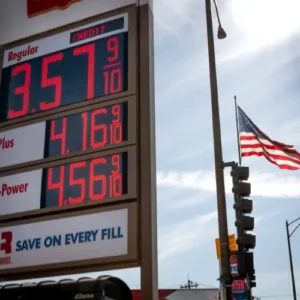
<div align=”center”>【84†embed_image】 *Trucks fueling at a highway station. Notice the diesel price sign ($3.88) – such prices would be much higher during an oil shock. In past conflicts, rapid **diesel price inflation** meant every mile cost more fuel. (Caption: Rising diesel price inflation leads directly to higher **trucking fuel costs** at the pump.)*</div>
These historical episodes show a common pattern: conflict -> spike -> eventual stabilization. They also teach a lesson about timing and volumes. In each case:
- Spike: News of fighting or strikes sends oil to $90–$110 range, dragging U.S. diesel up. For example, when Brent neared $105 in 2011, U.S. average diesel jumped ~30% relative to before.
- Initial panic: Many brokers and carriers rushed to raise rates, causing a burst of freight rates volatility. Indeed, indices from 2011 show spot rates jumping for a few weeks on conflict news.
- Cooling off: Once supplies resumed or conflicts didn’t expand, prices fell. By late 2011–12, Brent settled back near $100, and trucking rates normalized. That tells us these shocks, while fierce, often have a short “half-life”.
For today’s carriers, the takeaway is to budget for the spike but expect relief. You can’t avoid a fuel shock, but you can manage it. We’ll apply these patterns to 2026’s outlook below.
Diesel price inflation and trucking costs
“Diesel price inflation” isn’t just an economic buzzword – it’s a real driver pain. Every penny up per gallon is a clear cost. Historical data show how conflict translated to higher prices. For instance, during the 2011 Libyan crisis, Brent hit about $103 and U.S. diesel prices followed: average on-highway diesel, normally ~$3.00–$3.50, spiked toward $4 by mid-2011. Today, we saw something similar: in March 2026, U.S. diesel leapt from $3.897 to $4.859 in just two weeks during the current Iran tension. That’s 20+% diesel price inflation in days.
What does that mean on the road? Every trucking operation feels it. Example math: a truck getting 7 mpg burns about 357 gallons for a 2,500-mile week. At $3.50/gal, that’s $1,250 fuel. At $4.50/gal, that’s $1,607 – an extra $357 out of pocket. Even owner-operators with fuel surcharges will note that carrier payroll has to account for those costs somehow. Over a fleet, this is trucking fuel costs rising thousands of dollars per week.
We should expect freight rate negotiations to reflect this. Indeed, indices like DAT’s spot rate index rose when diesel jumped, as carriers demanded more. But the effect is volatile. In past shocks, contracts signed before the spike quickly become unprofitable, pushing carriers onto the spot market or into detention claims. Dispatchers and owners see their profit margins squeezed until rates catch up.
Here’s a useful rule of thumb: each 10¢/gal diesel rise adds about 1.4¢/mi to break-even (at 7 mpg). That became common knowledge in 2011 among fleet managers, and it matters now. As one owner recalled from Libya times, “We didn’t hesitate to raise rates 3–4¢/mi when gas was $3.60 and shot to $4.20 in two weeks.” That kind of quick math is critical when diesel price inflation is on.
Fortunately, the diesel spike often ends. Historically, once the extra supply (or demand fear) reappears, diesel prices pull back. For example, after Libya’s 2011 spike to $103 Brent, output recovered and by late 2011 Brent was down to ~$95, easing diesel costs. The same happened after 2003 Iraq, 2019 Abqaiq attack, etc. This suggests fleets should prepare for volatility but not panic.
Because routes often involve several stops, structured vehicle transport dispatch processes alongside diligent car hauling load management ensure shipments proceed without confusion.
Freight rates volatility in the aftermath
Rising fuel did not just mean higher costs – it meant erratic freight rates. Freight markets tend to overshoot both ways. In these shocks:
- Spikes in spot rates: When diesel jumped, many carriers refused low-paying loads. This tightened capacity on key lanes, sending spot rates up temporarily. (Datapoints: Freight indices in Feb–Mar 2026 showed a week-on-week jump after news, even without a surge in volumes.) Drivers remember 2011 when van rates on many lanes shot up 10–15% in March as the Libyan news broke – then eased by summer. That’s classic freight rates volatility.
- Contract gyrations: Carriers on contract had fuel clauses, but sometimes those lag. Some rushed to renegotiate fuel surcharges or risk having big unplanned fuel bills. Those without escalators took the hit. Dispatchers played a big role keeping everyone on top of their surcharges and avoid “fuel included” traps without daily adjustments.
- Demand shifts: Uncertainty also changed freight patterns. Some shippers delayed purchases, others rushed imports. Diesel inflation can cut demand. In a few historical cases (e.g. 1973 embargo), recession pressure even followed the oil spike. For truckers, this means spot load availability can shrink or boom irregularly.
The net effect is that freight rates volatility means unpredictability in bookings. In spikes, be cautious on new commitments. In declining phase, watch for rate correction. Understanding the past helps: when Brent eased after Libya 2011, spot rates had a short-lived bonus then gave back gains. This is why in 2026 we advise drivers not to assume today’s inflated spot will last.
What smart dispatchers do differently
So how do we handle another round of conflict-driven fuel and rate chaos? By applying the old lessons:
- Up-to-date pricing: We update minimum rates daily during a spike. Instead of waiting for next week’s tariff, we use cents-per-mile math right now. This covers the trucking fuel costs impact. Then we fight to get that into each rate sheet or load invoice.
- Selective booking: We prioritize loads with quick fuel clauses or detention pay. In the past, carriers learned to reject loads that said “fuel included” without any adjustment clause. Smart carriers also avoid heavy deadhead on exposed lanes, since diesel inflation hurts empty miles the most.
- Communication: We keep brokers and shippers in the loop. Historically, well-communicated carriers got preferential treatment (brokers raised rates for consistent partners to avoid no-shows). We ensure status, ETAs, and delay reasons (like border holds) are documented. That paperwork is key, as it becomes a claim if detention pay is needed due to delays during a shock.
- Route flexibility: If conflict is in one region, we may redirect or re-classify freight. In 2011, some carriers detoured loads away from congested Middle East hubs. Today we might suggest longer but cheaper fuel stops, or bunkering strategies.
- Driver support: Stress spikes can lead to hasty driving. We advise safe parking choices and legal rest. A rested, safe driver protects your compliance record – which pays off in negotiating power when renewals come.
Dispatch Republic’s mission is to handle the fuel shock for drivers. We track fuel price data (like EIA’s weekly diesel indices) and instantly factor changes into your plan. Our dispatchers re-book quickly when conditions change. For example, if a load gets canceled or a fuel jump hits mid-trip, we already have a list of high-priority lanes or backhauls to plug gaps (a practice many fleets adopted in 2011). We also file claims immediately if the truck was delayed by a war-related closure or extra inspection, ensuring no cost is left on the table.<div align=”center”>【87†embed_image】 *A vintage pickup at a gas pump – a reminder that **diesel price inflation** touches every driver, old or new. (Caption: Every truck eventually faces higher **trucking fuel costs** during an oil shock. Lessons from past spikes help us plan around this pattern.)*</div>
Since open deck shipments can vary widely, some operations integrate both flatbed and step deck dispatch strategies. Combining these approaches often reduces complications when arranging permits and special routes.
Applying history to today’s outlook
The bottom line is this: past shocks typically did pass. Wars, strikes, and embargoes hurt in the short term but often resolved without permanent supply loss. Truckers learned to weather them. The 2003 Iraq case taught us not to panic when prices had already priced in supply constraints. The 2011 Libya lesson was more about de-escalating quickly and watching for the rebound.
Today’s trucking market outlook 2026 can use these lessons. We expect volatility, but we also expect prices to stabilize by late 2026 – as long as no supplier permanently drops out. As you budget and book loads for the year, use that historical “shock then calm” insight. Don’t overcommit on fuel hedges; instead keep liquidity to absorb the spike, knowing you’ll get some relief later. Keep your schedules flexible, and use dispatch support to manage what you can (routes, rebook, paperwork).
Always remember: markets “buy the rumor, sell the news.” In conflicts, oil often jumps on headline fears then retreats once the first shots are counted or diplomats intervene. That doesn’t mean every spike fizzles – but history suggests most do. The exception is if supply lines are cut (as happened in 1973). So far, most conflicts haven’t stopped the oil physically; they just made us nervous. In that sense, trucking can plan on handling spikes as temporary bruises rather than permanent changes.
Call to action
If you’re nervous about rising diesel price inflation and trucking fuel costs, get proactive dispatch help. Dispatch Republic can analyze each load’s risk, rebook when needed, and update your rates minute-by-minute during a shock. We communicate with brokers about fuel surcharges, handle detention invoicing for delays, and always advise on safe, low-cost routing.
Put our experience to work: we’ve guided drivers through spikes by 1) guarding your payout with real-time fuel math, 2) routing to minimize empty miles, and 3) ensuring every delay and expense is documented for recovery. History shows market volatility can level off – but the better you manage it now, the less damage it does. Contact Dispatch Republic to set up your shock-ready dispatch strategy and keep your business rolling through whatever comes.
If you’re an owner-operator hauling specialized freight, don’t go it alone. Explore Dispatch Republic’s box truck dispatch services and car hauler dispatch services to access top-paying loads and compliance support. Check out our car hauling dispatch services and blog for more tips. Our dispatchers are experts in car hauling loads, flatbed loads, and reefer loads – we can match your truck to the best freight and handle the paperwork. Let us help you keep your rig loaded, safe, and legal.
For a deeper dive into the hotshot hauling business, read our Box Truck vs. Dry Van: Which Is Better for Your Business? and Step Deck vs. Flatbed: Which Is Right for Your Fleet?
Ready to make the most of your trucking business? 🚚💨 Reach out to Dispatch Republic and let our experts help maximize your earnings with tailored reefer dispatch service and dry van dispatch service solutions. We’ll handle the logistics while you keep on truckin’. Contact our truck dispatch service to get started on the road to greater profits and less hassle!
For more detailed guides, check Dispatch Republic’s resources on dispatching and the trucking business. Recent FMCSA Rule Changes for Immigrant CDL Holders if you’re weighing career paths, and Hotshot Dispatch and Compliance: Key Regulations Every Dispatcher Should Know to understand the dispatch side of the business.
If you’re an owner-operator juggling multiple responsibilities, consider partnering with a professional truck dispatch service to take the load off your shoulders—literally. At Dispatch Republic, we specialize in helping carriers run smarter and earn more by expertly managing load boards, negotiating top rates, and handling paperwork for dry vans, reefers, flatbeds, box trucks, step decks, and even hotshots. Our team monitors multiple premium load boards around the clock, ensuring your truck stays loaded with the right freight, at the right rate, on the right lane. Whether you’re scaling up or just getting started, having a dedicated dispatch team in your corner means fewer empty miles, less stress, and more time to focus on driving and growing your business.
Frequently Asked Questions
What is diesel price inflation and how does it affect me?
Diesel price inflation means the price per gallon is rising quickly (as we saw when past Mideast conflicts hit). Every cent up adds to your operating cost. For example, going from $3.50 to $4.50/gal adds roughly $140/week extra fuel on a 2,000-mile week. The lesson from history is to expect some passing spike; then rates or fuel surcharges should catch up.
How have freight rates volatility behaved in past conflicts?
Historically, freight rates volatility spiked too. In 2011, spot rates jumped about 10-15% in weeks after Libya news, then cooled. Brokers likely will pay more to avoid rejections in the short run. But freight markets usually correct within months of a conflict easing. This is why dispatchers tell drivers to keep booking selectively and renegotiate rates as soon as fuel spikes.
Are previous oil price shocks predictive of future trucking market outlook 2026?
Not exactly predictable, but patterns help. We see that wars tend to cause short-term spikes and not permanent price resets. So if crude hits $100, remember past cycles. The trucking market outlook 2026 should include a brief period of tighter capacity and higher rates, followed by gradual easing. Plan for volatility now, and expect some normalization later in the year if no new supply hits.
What specific steps should I take in dispatch during a shock?
Based on past experience, you should: 1) Immediately recalc your fuel burn per load and add that to your min rate, 2) Demand clear fuel surcharges or detention terms on every load, 3) Avoid lock-in on long deadhead without flex, 4) Route through cheapest fuel stations even if slightly longer, and 5) Park safely and log every minute if delays happen (we help with paperwork to invoice that time).
Can a dispatcher really protect my margins against these shocks?
Yes. A good dispatch service treats diesel price inflation like any other cost line item. We’ll re-book loads if current rates won’t cover your new fuel cost, speed up invoicing, and check that fuel surcharges are applied correctly. In past shocks, carriers who worked closely with dispatchers came out ahead because they could adapt their plan day-by-day, instead of being locked into outdated price levels.
Why didn’t every conflict cause a long-term price surge?
It usually comes down to supply. In most wars, no single country permanently lost output. Markets reacted on fear, but once fighting settled, supply (or alternative sources) kept coming. By contrast, only the 1973 embargo (lasting months) held supply static. The takeaway is that trucking should plan for that early fear spike, then watch for the supply news to guide the next steps.
Will insurance or regulations change in response to another shock?
Not directly. Insurance can tighten on war-risk routes, but for domestic trucking it’s fuel and demand that matter more. The real action is in freight and fuel. Regulations like CDL rules won’t impact fuel costs. Just keep all your paperwork and safety record clean, so when demand comes back you qualify for the best jobs.
Ready to Take Your Trucking Career to the Next Level?
Whether you’re an owner-operator, a company driver, or a carrier company in need of truck dispatch services, Dispatch Republic is here to help. Our team of experienced truck dispatchers offers affordable, professional truck dispatch solutions designed to save you time, increase your earnings, and make your business more efficient.
Thinking about outsourcing your truck dispatching? Contact Dispatch Republic today and move smarter, not harder.
Found our Blog useful? Spread the word:
Check our latest posts:

Contact us today to see how our team can support your trucking business.