
Table of contents
The gap is expensive now
A lot of carriers still think every dispatcher does the same basic job: find a load, book it, send the rate con, answer the phone, move on. From far away, that sounds true. From inside a trucking business, it is dead wrong. The gap between average and high-performing dispatch is not a small service difference anymore. It is a margin difference, a stress difference, and in some cases a business survival difference.
The last two years made that gap impossible to ignore. ATRI’s 2025 update put average operating cost at $2.26 per mile in 2024, and it said non-fuel costs rose to a record $1.779 per mile. DAT then reported that the average March 2026 spot van rate reached $2.52 per mile, but linehaul still weakened month over month because fuel surcharges surged. EIA showed U.S. on-highway diesel averaging $5.523 per gallon on May 25, 2026. That is exactly the kind of market where a “good” gross rate can still be a bad business decision. Learn more about 2026 Diesel Price Forecast: What Fuel Inflation Means for Your Rates.
In that kind of market, the best dispatch company is not the one that talks the most. The best dispatch company is the one that protects time, protects margin, and keeps a carrier from stepping into preventable trouble.
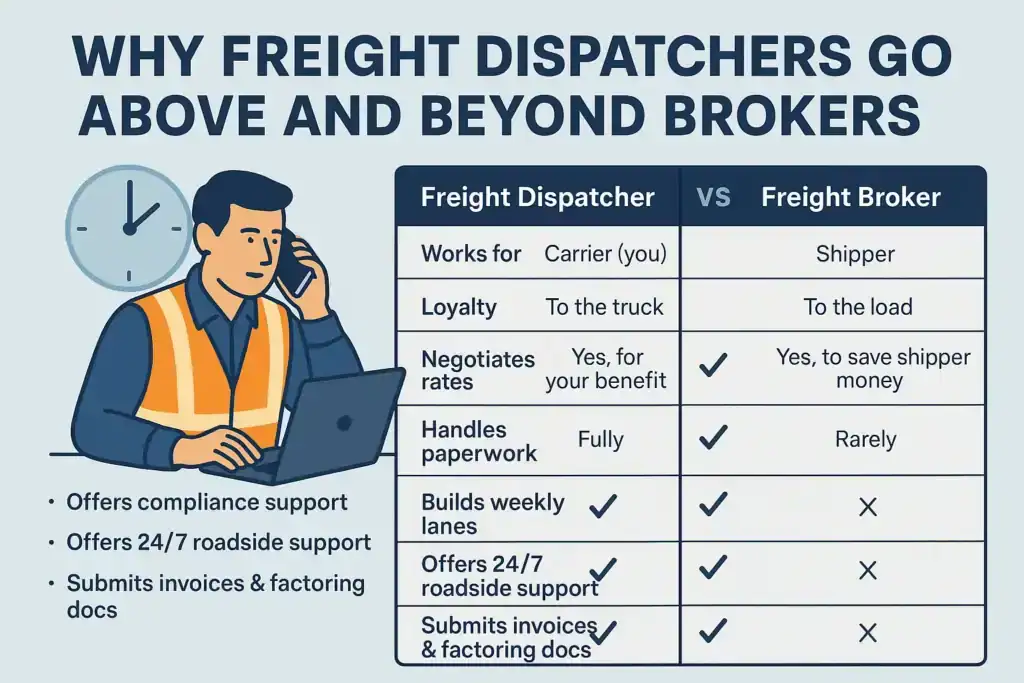
When drivers ask for best dispatcher help, they usually are not asking for motivational talk. They are asking for somebody who can stop a bad week before it starts. Best dispatcher help means somebody catches the weak broker, the cheap reload trap, the missed appointment window, the lazy paperwork habit, or the compliance detail that can turn one roadside stop into a bigger problem.
That is where carrier support separates the real operators from the pretenders. Carrier support is not a cheerful text message at noon. Carrier support is somebody checking whether the load fits the truck, the hours, the receiver, the reload market, and the cash flow timing. Good carrier support makes a driver feel less alone without taking control away from the carrier.
The same thing is true with MC DOT compliance. Too many dispatchers talk about MC DOT compliance like it is a back-office side note. It is not. MC DOT compliance touches authority status, registration access, ELD readiness, driver qualification issues, inspections, and the basic habit of keeping records current. If a dispatcher cannot speak clearly about MC DOT compliance, that dispatcher is working too close to the fire.
From our side of the business, this is the blunt truth: a dispatcher who only chases the highest gross rate is usually expensive in ways the carrier does not see until Friday. A high-performing dispatcher thinks in usable hours, real miles, reload strength, detention odds, broker quality, and how fast that load turns into money. That is why the best dispatch company usually looks calmer than the average one. Calm is not laziness. Calm is systems.
What average dispatch services still get wrong
Average dispatch services still make the same mistake over and over: they confuse activity with results. They will send ten load options, make twenty calls, and brag about being busy. But busy is not the same thing as productive. A carrier does not need noise. A carrier needs a good decision at the right time. The best dispatch company knows that one smart load can beat three sloppy ones.
The first bad habit is rate-first thinking. Average dispatchers see a decent all-in number and stop there. They do not score the appointment, the deadhead, the unload risk, the lane exit, or the chance that the load strands the truck in a soft market. Best dispatcher help starts with better filters. Best dispatcher help means asking what the load does to the next day, not just to the next two hours.
The second bad habit is fake carrier support. A dispatcher says there is carrier support because they answer calls, but real carrier support includes broker checks, clear trip notes, clean paperwork, and fast follow-up when detention, TONU, or lumper money needs to be documented. Carrier support also means telling the carrier when a load is not worth taking. That sounds small until it saves 300 empty miles and a ruined reset.
The fraud side of this is not theoretical anymore. FMCSA’s fraud alerts page keeps warning carriers about SAFER impersonation, bogus carrier-status notices, fake compliance messages, and scams involving USDOT and MC numbers. DAT wrote in January 2026 that current fraud patterns increasingly use stolen identities, impersonated carriers, altered documents, and payment-change schemes. Truckstop’s 2025 broker survey found that two-thirds of brokers cite fraud as a top issue, and 86% of brokers who experienced fraud pointed to double brokering. NICB said cargo-theft losses increased 27% in 2024 and were expected to rise another 22% in 2025; Verisk CargoNet later estimated nearly $725 million in 2025 losses, up 60% from 2024, with confirmed cargo theft incidents up 18%. If a dispatcher still books like nothing has changed, that is not confidence. That is carelessness. Here you can read our article about The Dispatcher’s Role in Preventing Cargo Theft.
The third bad habit is treating MC DOT compliance like somebody else’s department. That is one of the fastest ways an average service becomes a liability. MC DOT compliance now sits closer to dispatch than many people want to admit. FMCSA stopped accepting paper registration transactions after September 30, 2025. Motus went live in May 2026 with biometrics and data analytics, but FMCSA also says the first release does not eliminate MC/FF docket numbers. FMCSA added new Clearinghouse identity verification on April 27, 2026, restored English-language out-of-service enforcement on June 25, 2025, and removed 12 ELDs from the registered list in May 2026 with a 60-day replacement window. A dispatcher who is not current on those basics is not giving real carrier support, no matter how fast they answer the phone.
Another weak spot is communication style. Weak dispatchers disappear when a pickup gets messy. They get loud on easy days and quiet on hard days. Strong dispatchers do the opposite. They get more useful when the day turns bad. Best dispatcher help means clear check calls, documented times, direct talks with brokers, and fast decisions when the original plan is gone.
And yes, average services still overload each dispatcher. That detail matters more than companies admit. If one agent is juggling too many trucks, carrier support gets thinner by the hour. The check call gets late. The rate confirmation is missing one note. The receiver change does not get passed along. The driver waits. The broker blames the carrier. Suddenly MC DOT compliance is not the only thing under pressure. The whole day is.
What high-performing services do differently every week
High-performing dispatch is less glamorous than social media makes it look. It is not mostly persuasion. It is mostly preparation. The best dispatch company builds a repeatable weekly rhythm: vet the freight, score the time, protect the lane, document the terms, and shorten the money cycle. The best dispatch company does not rely on luck or hype because luck only scales until it turns against you.
One real difference is margin math. Strong dispatchers do not stop at “good rate per mile.” They ask what the load pays after fuel mood, deadhead, short-night parking pain, unload delay, reload weakness, and billing lag. Best dispatcher help is often one sentence long: “Skip this one. It looks good, but it will steal half your day.” Drivers remember that kind of best dispatcher help because it saves them from the freight that always sounds better than it runs.
High-performing teams also treat carrier support like an operating system. Carrier support means the dispatcher knows the carrier’s lane preferences, appointment tolerance, home-time needs, paperwork habits, and red lines. Carrier support should feel consistent, not random. A driver should not have to re-explain the same basics every Monday morning. If that happens, the dispatcher is not managing the business. The driver is managing the dispatcher.
The compliance side is just as practical. MC DOT compliance in a serious dispatch operation is not there to sound professional. It is there to keep freight access open. A good dispatcher knows when a carrier needs a clean biennial update, who has access to the Portal, what changed with registration systems, and why small clerical laziness turns into big downtime. FMCSA says the MCS-150 is still the form used to keep an existing USDOT record current and fulfill the biennial update, and it also says only the Portal Company Official using the same Login.gov email can claim a Motus account for the first time. Good MC DOT compliance is boring on purpose. Boring keeps trucks moving.
Strong dispatchers also negotiate beyond linehaul. They do not act like detention, layover, TONU, extra stops, and facility-specific delays are side stories. They know those terms control the real day. That is why the best dispatch company often sounds more detail-oriented than the average one. The best dispatch company is not trying to be difficult. It is trying to keep a simple load from becoming unplanned charity work. The FMCSA proposed broker-transparency rule published on February 18, 2025 would require brokers to provide transaction records electronically within 48 hours of a request. High-performing dispatchers do not wait for a final rule to start acting like documentation matters. They ask better questions earlier.
Another difference is paperwork speed. Best dispatcher help is not finished when the truck unloads. Best dispatcher help includes getting the signed documents back fast, checking them, and keeping billing from drifting. This is one of the least flashy parts of carrier support and one of the most valuable. Cash flow is where good dispatch quietly proves itself. Carrier support that stops at load booking is not full carrier support. Learn more on how best dispatchers handle the pressure in our article What Does a Truck Dispatcher Do?
High-performing dispatchers are also better at saying no. That matters because every truck has a limit. Every driver has a limit. Every week has one or two loads that can wreck the sequence. MC DOT compliance matters here too, because bad dispatch and bad compliance often show up together. The service that books unrealistic days is usually the same service that ignores hours, ignores inspection exposure, and treats sequence planning like an afterthought. That is not hustle. That is borrowed trouble.
And the hours math still matters. FMCSA’s property-carrying rules still revolve around the 11-hour driving limit after 10 consecutive off-duty hours, the 14-hour window, the 30-minute break after 8 cumulative driving hours, and the 60/70-hour limit. In FMCSA’s September 2025 SMS methodology, HOS BASIC prioritization starts with at least three relevant driver inspections, while Vehicle Maintenance starts with at least five relevant vehicle inspections. That means weak dispatch can hurt a carrier twice: once in the load outcome and again in the safety record.
There is another point that carriers feel almost immediately: a strong dispatcher protects optionality. The best dispatch company thinks about what happens after delivery. Best dispatcher help is future-focused. Carrier support includes planning the next market, the next broker call, the next reset location, and the next clean document handoff. MC DOT compliance supports that same goal because freight access depends on keeping the record clean enough to stay bookable and dependable.
High-performing dispatchers also keep one eye on the record side of the market. FMCSA says public property-carrier SMS data includes inspection and crash data, investigation results, and public BASIC measures, even though some categories remain hidden from public view. FMCSA’s current Prioritization Preview also shows the agency moving toward reorganized BASICs under new “compliance categories.” The practical lesson is simple: serious dispatchers do not run blind on safety exposure.
Why box truck operations expose weak dispatch fast
If you want to see the real quality of a dispatcher, put that dispatcher on a busy box truck operation for a week. A box truck dispatch service exposes weak planning fast because there is less room to hide. A late pickup hurts more. A wrong appointment hurts more. A weak reload hurts more. A box truck dispatcher cannot just lean on long-haul miles to cover mistakes.
That is why a serious box truck dispatch service works in time blocks, not just mile counts. A good box truck dispatch service looks at stop density, liftgate needs, city access, unload speed, parking, and the next day before accepting a load. A smart box truck dispatcher knows that a shorter run can outperform a longer run if it sets up a cleaner second move and a cleaner tomorrow.
Average dispatchers get box truck work wrong in a very specific way. They chase the top gross local load and ignore what it does to the rest of the day. Then the truck gets stuck at a receiver, misses a second option, and finishes with less money than a simpler plan would have produced. The best dispatch company understands that box work punishes sloppy sequencing. Best dispatcher help in this niche means being realistic about minutes, not just miles.
Carrier support matters even more with a box fleet because the driver’s day often has more touchpoints. Carrier support for this type of operation includes better call notes, sharper location details, stronger appointment confirmation, and quick accessorial follow-up. If the dispatcher is slow, the whole day feels slow. In box work, carrier support is not a luxury. It is the difference between a clean route and a day that unravels one stop at a time.
MC DOT compliance also shows up in box truck work more often than new carriers expect. If the operation falls under FMCSA rules, the dispatcher still has to think about available hours, short-haul limits where they apply, ELD status where required, and the basic discipline of not overpromising the day. FMCSA’s short-haul exception still depends on staying within a 150 air-mile radius and a maximum 14-hour duty period. A sloppy box truck dispatcher will overbook because a city map looks small on a screen. A professional box truck dispatcher knows that urban miles can be slow miles.
Here is a simple scenario we have seen in different forms for years. Dispatcher A books three short loads for a box unit because the gross revenue looks strong. Dispatcher B books two loads with tighter appointment logic, less wasted repositioning, and a better chance at same-day paperwork. Dispatcher A wins the morning screenshot. Dispatcher B wins the week. That is the kind of difference the best dispatch company notices early and average services miss completely. Learn Box truck dispatch secrets and tips in our article on Box Truck Dispatch Secrets: A Guide for Owner Operators.
The same thing happens with communication. Best dispatcher help for box carriers often sounds simple: a clear facility note, a warning about dock delay, a heads-up about required equipment, or a firm call to get accessorial terms in writing before the truck commits. But that simple best dispatcher help is exactly what keeps small mistakes from stacking. For tight city work, carrier support has to be sharper, faster, and more specific.

For this reason, we always tell carriers to ask direct questions about the actual human running their freight. A box truck dispatch service is only as good as the box truck dispatcher assigned to the account. A box truck dispatch service can have a polished website and still fail on timing. A box truck dispatcher who understands your market can quietly outperform a louder competitor. That is why the best dispatch company in this segment is usually the one that plans the day like a local operator, not like a generic load booker.
And one more thing deserves saying out loud: a box truck dispatch service should never feel like the dispatcher is learning your business at your expense. A well-run box truck dispatch service should already understand appointment discipline, touch freight realities, direct freight quirks, and how one bad urban stop can poison the rest of the day. A seasoned box truck dispatcher does not need drama to add value. A seasoned box truck dispatcher adds value by making the day less dramatic. A reliable box truck dispatch service gives the box truck dispatcher enough time to plan the next move. The wrong box truck dispatch service pretends every day can be fixed on the fly.
Questions to ask before you sign
Most carriers do not need a dramatic sales pitch. They need a clean way to tell whether a dispatcher is average or actually useful. These are the questions we think matter most.
Ask how they score a load beyond rate per mile. The best dispatch company should talk about deadhead, timing, reload strength, and facility behavior. If the answer sounds like “we always fight for the highest rate,” keep listening carefully. Best dispatcher help is usually more detailed than that. Best dispatcher help includes when not to run the load at all.
Ask what carrier support looks like on a bad day, not on a normal day. Carrier support should include broker communication, check calls, document handling, accessorial follow-up, and rerouting when the original plan fails. Real carrier support also includes honest conversations when a driver needs a lighter sequence or when the week needs to be rebuilt around home time.
Ask who watches the basics of MC DOT compliance. Do not ask in a legal-theory way. Ask in a real-world way. Who checks record access? Who knows the Portal status? Who catches account issues before they become downtime? Who understands what changed with registration systems? If a dispatcher still tells you MC numbers disappeared already, that is not current. FMCSA says the first Motus release does not eliminate MC/FF docket numbers, and it says only the right Portal Company Official using the same Login.gov email can claim Motus for the first time. That is a simple test of whether the service actually stays current.
Ask what written carrier agreement they use and how they stay on the right side of dispatch-vs-broker rules. FMCSA has said its guidance helps dispatch services know when operations require broker authority, and FMCSA’s open-petitions page shows a December 1, 2025 petition asking for a new “Bona Fide Independent Dispatch Agent” category. In plain English, the issue is still live. If a dispatch service cannot explain its written relationship to the carrier and how it stays in its lane, that is not a small detail.
Ask how they vet new brokers and what their process is when something feels off. The best dispatch company should have a routine, not a vibe. Best dispatcher help here means second-channel confirmation, documented contacts, and a willingness to walk away from suspicious freight. That is not being picky. That is protecting the carrier.
If you run local or regional equipment, ask direct box truck questions. Ask how the box truck dispatch service plans multi-stop days. Ask how the box truck dispatch service handles detention on smaller direct loads. Ask what a box truck dispatcher does when a receiver changes the appointment or when the truck needs liftgate notes in writing. The answers will tell you whether the box truck dispatcher has actually done the work or just learned the right buzzwords.
Finally, ask how fast paperwork moves after delivery. Weak dispatch dies in the gap between a completed load and a completed file. Strong carrier support keeps the money cycle short. Strong MC DOT compliance keeps the records cleaner. Strong best dispatcher help keeps the truck positioned for tomorrow. When those pieces work together, the service starts to feel less like outsourcing and more like a real operating partner.
Final word from Dispatch Republic
The real difference between average and high-performing dispatch is not charm. It is operational honesty. Average dispatch sells optimism and then improvises. High-performing dispatch builds a system and then protects it.
If you are an owner-operator, small fleet, or growing box operation, do not hire based on volume of promises. Hire based on whether the dispatcher thinks like a business operator. The best dispatch company will protect your week, not just your next load. The best dispatch company will make best dispatcher help feel practical, not theatrical. It will turn carrier support into something you can measure. It will treat MC DOT compliance like a real business function. And if you run local work, it will make smart box-truck planning feel normal instead of heroic.
That is the standard we believe in at Dispatch Republic. We do not think drivers need more noise. We think they need cleaner planning, steadier communication, better carrier support, and stronger MC DOT compliance. We think the best dispatch company should feel steady on a bad day, not just polished on a sales call. If you want best dispatcher help from people who take carrier support seriously, respect MC DOT compliance, and know what a box truck dispatch service should really do, that is the conversation worth having.
If you’re an owner-operator hauling specialized freight, don’t go it alone. Explore Dispatch Republic’s reefer truck dispatch services and power only dispatch services to access top-paying loads and compliance support. Check out our car hauling dispatch services and blog for more tips. Our dispatchers are experts in car hauling loads, flatbed loads, and reefer loads – we can match your truck to the best freight and handle the paperwork. Let us help you keep your rig loaded, safe, and legal.
For a deeper dive into the hotshot hauling business, read our Box Truck vs. Dry Van: Which Is Better for Your Business? and Step Deck vs. Flatbed: Which Is Right for Your Fleet?
Ready to make the most of your trucking business? 🚚💨 Reach out to Dispatch Republic and let our experts help maximize your earnings with tailored hotshot dispatch service and dry van dispatch service solutions. We’ll handle the logistics while you keep on truckin’. Contact our truck dispatch service to get started on the road to greater profits and less hassle!
For more detailed guides, check Dispatch Republic’s resources on dispatching and the trucking business. Recent FMCSA Rule Changes for Immigrant CDL Holders if you’re weighing career paths, and Hotshot Dispatch and Compliance: Key Regulations Every Dispatcher Should Know to understand the dispatch side of the business.
If you’re an owner-operator juggling multiple responsibilities, consider partnering with a professional truck dispatch service to take the load off your shoulders—literally. At Dispatch Republic, we specialize in helping carriers run smarter and earn more by expertly managing load boards, negotiating top rates, and handling paperwork for dry vans dispatch service, reefers dispatch service, flatbeds dispatch service, box trucks dispatch service, step decks dispatch service, hotshots dispatch service and even car hauler dispatch services. Our team monitors multiple premium load boards around the clock, ensuring your truck stays loaded with the right freight, at the right rate, on the right lane. Whether you’re scaling up or just getting started, having a dedicated dispatch team in your corner means fewer empty miles, less stress, and more time to focus on driving and growing your business.
Frequently Asked Questions
What does the best dispatch company do that an average dispatcher usually misses?
The best dispatch company protects the whole trip, not just the booked load. A strong team checks lane fit, appointment risk, broker quality, document flow, and the reload plan. That is what best dispatcher help should look like in the real world.
How can best dispatcher help improve profit if rates still feel unstable?
Best dispatcher help improves profit by filtering out time-wasting freight, negotiating better terms, and keeping paperwork moving. A carrier does not always need a higher gross rate. Sometimes the win comes from cleaner timing, stronger carrier support, and fewer empty miles. The reason this matters more now is simple: operating costs stayed high while cost pressure shifted from fuel-free headline rates to actual time use and fuel exposure.
Why is carrier support such a big deal for owner-operators and small fleets?
Carrier support matters because small fleets do not have much room for wasted time. Good carrier support keeps drivers informed, helps fix delays fast, and creates a more stable week. Carrier support also matters when invoices, detention, and broker communication start piling up.
Why should a dispatcher care about MC DOT compliance if they are not the safety department?
Because MC DOT compliance affects freight access, timing, and avoidable downtime. A dispatcher who ignores MC DOT compliance is often the same dispatcher who overbooks hours, misses record issues, and leaves the carrier reacting instead of planning. It also means missing real rule changes, like current Portal and Motus requirements, English-language out-of-service enforcement, Clearinghouse identity checks, and revoked ELD deadlines.
When does a box truck dispatch service become worth paying for?
A box truck dispatch service becomes worth it when the driver’s time is better spent driving than chasing loads and sorting out appointment chaos. A good box truck dispatch service should make the day smoother, keep lanes tighter, and use a box truck dispatcher who understands stop density and accessorials.
What should I ask a box truck dispatcher before signing up?
Ask the box truck dispatcher how they plan multi-stop days, how they confirm appointment details, how they protect same-day paperwork, and how they recover when a local route breaks down. A real box truck dispatcher should answer with process, not slogans. And if the operation relies on short-haul planning, they should know the 150 air-mile and 14-hour basics without guessing.
Ready to Take Your Trucking Career to the Next Level?
Whether you’re an owner-operator, a company driver, or a carrier company in need of truck dispatch services, Dispatch Republic is here to help. Our team of experienced truck dispatchers offers affordable, professional truck dispatch solutions designed to save you time, increase your earnings, and make your business more efficient.
Thinking about outsourcing your truck dispatching? Contact Dispatch Republic today and move smarter, not harder.
Found our Blog useful? Spread the word:
Check our latest posts:
Contact us today to see how our team can support your trucking business.