

Table of contents
If you have been on the road long enough, you can feel when the market changes before a chart confirms it. Brokers call back faster. Bad offers disappear quicker. Loads that sat for hours now move in minutes. A few drivers around you start saying the same thing: maybe the market is finally turning.
They are not wrong. But this part matters: a hotter board does not automatically mean better business.
That is where a lot of owner-operators get burned. They notice tighter conditions, assume every posted rate is a gift, and start running freight they should have refused two years ago and should still refuse now. They deadhead too far into crowded markets. They grab loads with ugly appointment windows. They accept “good” all-in rates that turn out to be mediocre linehaul after fuel and wait time. Then they wonder why the week felt busy but the settlement still looked thin.
That is the real conversation around truck market rates 2026. Yes, truck market rates 2026 are stronger than what most carriers lived through in 2024 and much of 2025. Yes, tight capacity trucking is very real in several parts of the market. Yes, the best dispatch for owner operators can finally do more than just keep the wheels turning. And yes, there are more high paying loads on the board than there were a year ago. But none of that means you should chase everything that moves.
From the dispatch side, we see the same pattern every time the cycle tightens. The carriers who win are not the ones who run the hardest. They are the ones who filter the hardest. They know what their truck needs to gross, what their lane history tells them, what kind of broker behavior usually turns into lost time, and where the reload is before they book the first leg. In a market like this, dispatch for owner operators should act like a screen, not a megaphone. The job is not to shout that rates are up. The job is to make sure the truck lands on the right freight, in the right place, at the right time.
This article breaks the market flip down in plain English, then shows how a good dispatcher turns tight capacity trucking into better booked freight, less deadhead, and smarter lane selection.
The market really did flip
The biggest mistake we hear is simple: “freight demand is booming again.” That is not the full story. The cleaner read is that truck market rates 2026 started moving up faster than freight volumes because available capacity got tighter, not because freight suddenly exploded everywhere.
That difference matters. If demand were roaring across the board, you could get away with more trial and error. In the current setup, you still need discipline because the market remains uneven by equipment type, region, commodity, and time of week. Tight capacity trucking is not the same thing as broad, easy money.
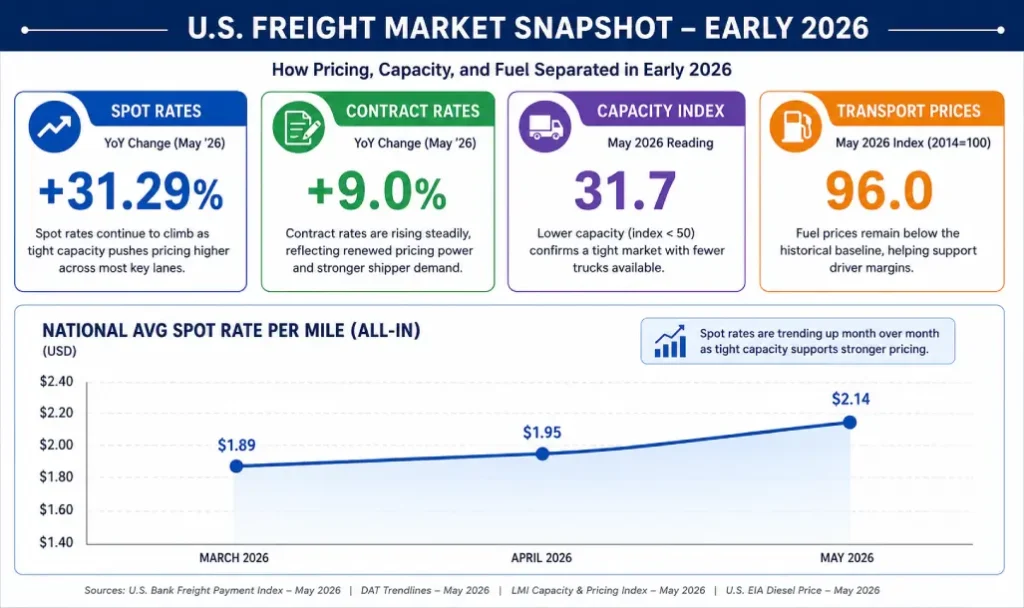
Several 2026 data points line up on that. U.S. Bank’s Q1 2026 Freight Payment Index showed shipments basically flat, down 0.3% quarter over quarter and up only 0.6% year over year, while shipper spend jumped 12.9% from Q4 and 21.8% from a year earlier. That is a classic pricing-power story. Spot rates averaged $2.56 per mile in Q1, up 11.9% from Q4, while average fuel cost reached 51 cents per mile. In other words, truck market rates 2026 moved higher even though volume barely budged.
Learn more about market rates growth reading our new article on Why Spot Rates Are Finally Moving Up and What a Good Dispatcher Does With That Window.
The same pattern showed up in the dry van rate data. In U.S. Bank’s 2026 Rates Edition, dry van spot linehaul went from $1.57 per mile in May 2025 to $2.01 through February 2026, about a 28% climb. Contract linehaul rose too, but much slower, from $1.99 to $2.12. Spot caught up to contract, and the contract premium compressed from roughly $0.39 per mile to about $0.11. That is why dispatch for owner operators became more valuable this year. When spot closes in on contract, small carriers who know how to choose freight can finally compete on selection, not just survival.
Cass showed the same tone in May 2026. Shipments improved month to month, but they were still down 1.2% year over year. Expenditures, though, rose 7.5% year over year. Again, not a freight boom. A pricing shift.
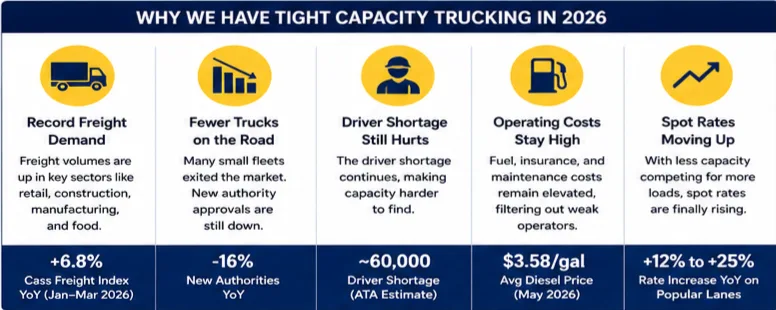
ACT Research put it more directly in late June: the truckload cycle in 2026 has been supply-driven, with spot rates on track to rise more than 40% year over year in June, net fuel, while driver availability stayed deep in shortage territory. Logistics Managers’ Index data backed the move from another angle. Transportation capacity stayed in contraction in spring 2026 while transportation prices exploded, including a record 96.0 reading in May and still a very high 92.4 in June. When pricing is that hot while capacity is that tight, you are looking at a supply squeeze, not a simple demand surge.
A few more signals matter here. FRED’s truck tonnage series rose from 114.1 in January 2026 to 117.7 in April. That is improvement, but it is not the kind of straight-up surge that would explain rate inflation by itself. Arrive Logistics said June conditions were still being defined mainly by high operating costs, lower driver availability, and regulatory pressure, with tender rejections staying well above prior-year levels. In early June, overall tender rejections had peaked just under 18%, dry van rejections moved above 18%, reefer peaked near 25%, and flatbed stayed elevated in the 30% to 40% range. Reuters also reported in March that tight truck capacity was opening a window for railroads to win back freight, another sign that the squeeze was big enough to change shipper behavior.
So yes, truck market rates 2026 are stronger. But the smart read is not “everything pays now.” The smart read is “the margin for good decision-making is finally back.”
Why the board feels hotter than the economy looks
When owner-operators tell us the board feels different, they are usually reacting to speed. Loads fill faster. Rate conversations are shorter. Brokers sound more nervous about coverage. That is real. But if you want to turn that feeling into money, you have to understand what is behind it.
First, the market is selective. DAT said the dry van load-to-truck ratio reached 18.53 in late May, with volume 63% above the year before and equipment availability 43% below the long-term average since 2017, excluding the pandemic years. That is a major change from the weak conditions most small carriers were fighting through. But DAT also noted earlier in 2026 that capacity is not simply gone; it has become selective. Carriers are being more deliberate about where they place equipment. That is good news for disciplined operators and bad news for people who still run random freight just because it is on the screen.
Second, some of the headline move came with fuel. The national on-highway diesel average was still $4.668 per gallon on June 29, 2026, with the West Coast at $5.528 and California at $6.180. In Q1, U.S. Bank put average fuel expense at 51 cents per mile. Reuters also reported in April that surging diesel costs were hitting small truckers especially hard. So when you look at truck market rates 2026, do not stop at the all-in number. Separate the linehaul from the fuel effect. If you do not, you can think you booked one of the week’s high paying loads when you really just booked a load in an expensive fuel week.
Third, mode and lane matter more than social-media market talk. Reefer got squeezed hard in produce. DAT reported that all nine lanes moving out of the South Texas Mexico crossings were at slight shortage in March 2026, the first time that had happened in its 2026 tracking, with Dallas reefer all-in rates up 17%, Miami up 9%, and Baltimore up 8% on outbound produce freight. Flatbed has been even more stubbornly tight in spring and early summer. Arrive said flatbed rejection rates stayed in the 30% to 40% range in mid-June, and its June update said flatbed load-to-truck ratio was up 189% year over year in May. That is why tight capacity trucking can feel very different depending on what you haul and where you sit.
This is where weak dispatch hurts owner-operators. Weak dispatch hears “tight market” and sends the truck wherever the loudest rate spike is. Good dispatch for owner operators reads truck market rates 2026 lane by lane. It asks what is paying now, what reloads reliably, what dwell risk is attached, and what direction the truck needs to move by Friday, not just by noon.
A simple scenario makes the point. Imagine a dry van owner-operator in Indianapolis sees a flashy outbound load to South Florida at a strong all-in rate. On paper, it looks like one of the best high paying loads of the day. But the reload market is soft, appointment windows are tight, and the truck may sit for a day and a half waiting on the next move. A second option pays less on the first leg into the Midwest, but it lands in a zone where reload density is stronger and the roundtrip math is cleaner. The first load looks bigger. The second load usually pays better by Friday.
The board feels hotter because coverage is tighter. But the profit is still in the sequence.
What a good dispatcher does when rates rise
In a loose market, dispatch spends a lot of time just trying to keep a truck moving. In tight capacity trucking, the job changes. A useful dispatcher stops being a finder of loads and becomes a manager of choices.
That sounds small, but it changes everything.
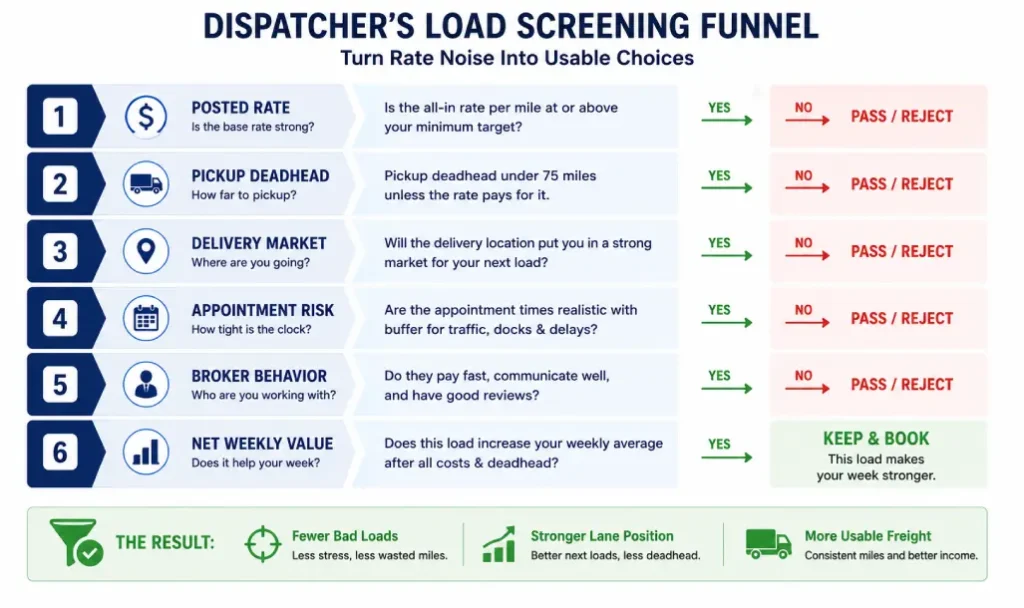
The first job is screening for real margin. A strong dispatcher does not ask only, “Can I get this load booked?” The better question is, “Is this one of the high paying loads after deadhead, fuel, accessorial risk, and reload position?” Truck market rates 2026 created more chances to negotiate, but carriers only keep that advantage if dispatch for owner operators protects the margin inside the details.
That means checking at least five things before saying yes.
One is the real linehaul. If diesel is elevated and the broker is selling the load off an all-in number, dispatch has to know what part of that load is actual rate strength and what part is just a temporary fuel bump. This sounds basic, but it is one of the easiest places to get fooled during truck market rates 2026.
Two is the appointment structure. A load that pays well but forces an overnight wait, a blindside problem, or a late unload that kills the next day is often not one of the week’s high paying loads in real life. Tight capacity trucking makes brokers more urgent. It does not make dock time any less expensive.
Three is the reload map. Truck market rates 2026 are improving, but random freight still punishes random routing. Good dispatch for owner operators should know the likely reload before the first rate confirmation is signed. If the answer is “we’ll figure it out later,” that usually means the truck is being guessed at, not managed.
Four is broker quality. In April 2026, the FBI warned that cyber-enabled strategic cargo theft had surged, with estimated U.S. and Canada losses nearing $725 million in 2025, up 60%, and the average theft value rising to $273,990. Criminals have been using spoofed emails, fake URLs, compromised accounts, and fraudulent load postings to hijack freight. In a hotter market, bad loads are not always cheap loads. Sometimes they are fake loads. That makes serious broker vetting part of modern dispatch for owner operators, especially when the board gets busy.
Five is schedule fit. The best dispatch for owner operators still works around hours, home time, service commitment, and equipment strengths. Tight capacity trucking gives leverage, but it does not cure bad trip planning.
This is also where negotiation changes. When truck market rates 2026 rise, weak dispatch accepts the posted number. Strong dispatch asks for the missing pieces. That can mean detention terms in writing, layover protection, a clearer commodity description, fuel consideration, driver assist pay, stop pay, or a revised appointment window. U.S. Bank’s rate data showed pricing power shifting with tighter capacity, and Arrive’s June report said routing guide disruption was still pushing more freight into the spot market. That gives good dispatchers a better reason to push.
One more point from our side: dispatch for owner operators should not try to “win” every call. It should preserve the truck’s position. Sometimes the best move in tight capacity trucking is to pass on the wrong freight and wait two hours. Drivers hate hearing that in the moment, but it is often the reason Friday numbers look better.
Read more about having the right truck dispatcher importance on our article about How Professional Hotshot Dispatchers Find Better Loads Than Most Drivers.
How to choose better freight without getting trapped
The phrase high paying loads gets thrown around too loosely. A high posted rate is not the same thing as a high-quality load. If the load burns half a day at the dock, drags you into a weak reload zone, or ties up your hours so badly that the next two days get ugly, it was never one of the true high paying loads.
This is the part owner-operators need to slow down for.
When truck market rates 2026 are climbing, a lot of bad freight gets dressed up as good freight. The higher market covers up schedule problems. It hides broker urgency. It makes deadhead feel acceptable. It tempts drivers to accept lanes they do not normally run and customers they do not really trust. That is exactly why dispatch for owner operators needs a harder set of rules in tight capacity trucking, not a softer one.
Our rule is simple: judge the load in a chain, not by itself.
Ask these questions in order. Where does this load leave the truck? How much unpaid repositioning does it require before pickup? What is the realistic unload time, not the promised one? Can the truck reload the same day or the next morning? Does the lane fit the truck’s normal profit pattern? Is the commodity or pickup setup likely to create claims, delays, or fraud risk?
If those answers are weak, the rate has to be very strong. Usually stronger than the board says.
DAT’s more recent carrier tools keep pushing the same lesson: reduce empty miles, study the return lane before you book the outbound, and line up backhauls earlier. That logic matters even more now because truck market rates 2026 are giving owner-operators a short window where better planning is finally rewarded. If you ignore the reload side, you waste the window.
Let’s use another simple scenario.
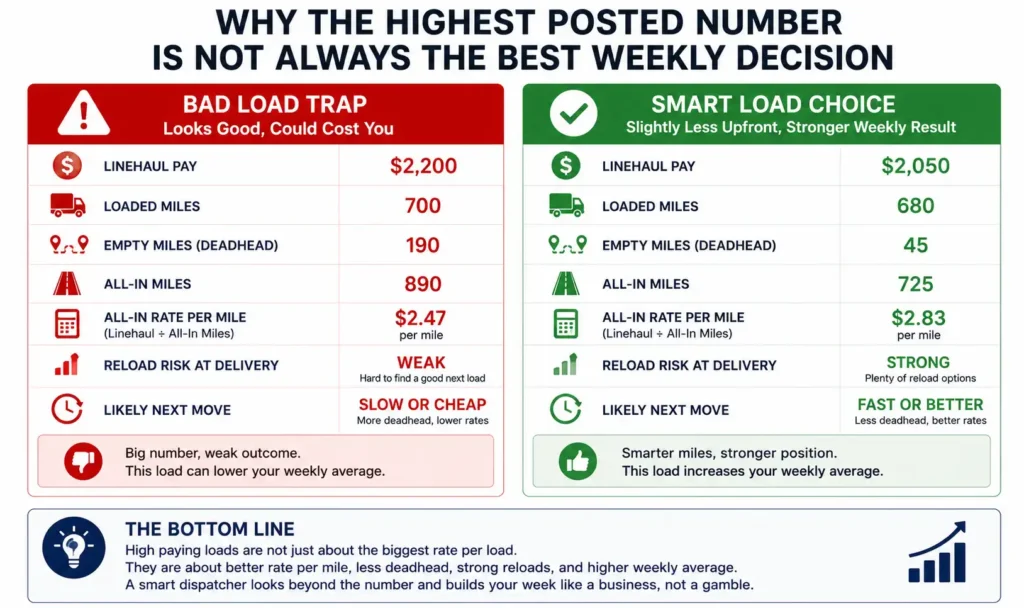
Load A pays $3,050 on 980 loaded miles. That sounds like one of the better high paying loads on the screen. But it needs 120 deadhead to pickup, unloads late, and leaves the truck in a soft market where the next day starts with 140 more empty miles. By the time the truck gets moving again, the gross looks a lot less impressive.
Load B pays $2,450 on 760 loaded miles. It is not flashy. But pickup is close, unload is clean, and the truck lands in a reload market where a short next-day outbound is highly likely. By the end of the second load, Load B often wins the week. Good dispatch for owner operators lives inside that math.
This is also why we tell carriers not to chase every hot market. Reefer valleys, border freight, storm recovery zones, construction pockets, all of them can throw off great numbers. But truck market rates 2026 still punish trucks that arrive late to the story. When social media says a market is hot, half the country already heard it. Tight capacity trucking rewards timing, not rumor.
One sharp example from 2026 was the disruption around CVSA’s International Roadcheck in May, which focused on ELD tampering and cargo securement. Capacity tightened around the event, and Arrive reported that the volatility carried into early June before stabilizing. If you were positioned well before the squeeze, great. If you deadheaded into the chaos after everyone else, not so great. Dispatch for owner operators needs to understand that difference. A market event can create high paying loads, but it can also create expensive chasing.
In short, the best high paying loads usually have three things at once: decent linehaul, controlled time risk, and a useful next market. That is how the best high paying loads stay profitable after the rate con, the fuel bill, and the reload are all counted. If one of those is missing, it had better be compensated somewhere else.
The lane strategy that keeps more of the upside
If there is one habit we would force into every small carrier business during truck market rates 2026, it is this: stop running your truck like a tourist.
The owner-operators who capitalize on tight capacity trucking are usually not the ones bouncing into a new state every other day. They are the ones who learn three to five repeatable corridors and start reading them better than the average broker on the phone.
That matters because improving truck market rates 2026 create more pricing opportunities, but lane familiarity is still where margin gets protected. A dispatcher who knows your outbound lanes, reload habits, customer pain points, and bad pockets can do more with a better market than a generalist who just refreshes the board harder.
Here is what smart dispatch for owner operators usually looks like in a tightening market. It narrows the operating map instead of widening it too fast. It builds freight around reload probability, not just rate spikes. It watches where deadhead is strategic and where it is just expensive optimism. It groups brokers by actual behavior, not by what they claim on a call. It protects service on the customers who pay fairly when capacity is tight.
A lot of carriers resist this because they think specialization limits opportunity. In reality, specialization helps you recognize real opportunity faster. When truck market rates 2026 move, you do not have time to relearn every market from scratch. You want dispatch for owner operators that already knows which Thursday outbound usually reloads well on Friday, which broker tends to stretch detention, which produce lane is worth it only if pickup is early, and which premium market turns into a weekend trap.
Arrive’s June report summed this up in a useful way: after the July Fourth disruption, many shippers were expected to use mid- to late July as a prime chance to reset contract pricing for the rest of the year. That means the market may stay firmer for longer even if summer volatility cools. In plain English, the current window is not just about grabbing the next high paying loads. It is about building lane position before more pricing resets flow into the system. Good dispatch for owner operators should be planning for that, not reacting after it.
For dry vans, that may mean using strong Midwest and Southeast density to keep reloads tight and empty miles low. DAT said the Midwest, which handles nearly half the nation’s load volume, was still showing strong activity in its primary corridors, with rates around $2.67 in early June and the top 50 DAT lanes averaging $2.75. For reefer carriers, the lesson may be even more lane-specific: produce squeezes can be excellent, but only if the truck has a disciplined exit plan from the market. For flatbeds, lane selection matters because manufacturing and construction strength can make one region look incredible while the next reload still falls flat.
Here is the hard truth: truck market rates 2026 are good enough to reward lane strategy again. That is not the same as saying every lane deserves your truck.
Read more about market changes on the hotshots example in our new research on How Freight Market Changes Affect Hotshot Truckers.
The next sixty days from a dispatcher’s desk
If we were setting a short operating plan for an owner-operator right now, it would not start with “run more.” It would start with “tighten your rules.”
Truck market rates 2026 are giving small carriers more leverage than they had for a while, but leverage disappears fast when discipline disappears. Tight capacity trucking creates a window. It does not remove the need for planning.
This is the practical playbook we would use from the dispatch desk.
Start with a lane floor. Know the minimum linehaul rate, not just all-in rate, that makes sense for your truck on your main corridors. Recheck it weekly because truck market rates 2026 are moving faster than they were last year.
Track the deadhead honestly. Not optimistic deadhead. Real deadhead from where the truck will actually be. Dispatch for owner operators breaks when people pretend 90 unpaid miles are basically nothing.
Book the next move earlier. In a firmer market, waiting until delivery to think about reload is lazy. The best dispatch for owner operators is already looking at the second leg while the first one is being negotiated.
Use patience as a tool. In tight capacity trucking, one or two hours of patience can create much better rate options than panic-booking a weak load at 10:15 a.m.
Push for written accessorial terms. Rate strength is helpful, but surprise wait time still kills margins. Better markets are the right time to clean up load terms, and they are also the right time to separate real high paying loads from loads that only look expensive on the first phone call.
Tighten broker checks. The FBI cargo theft warning should have ended the old habit of trusting a decent-sounding email. High paying loads attract attention from criminals too.
Protect your service score with the brokers worth keeping. As pricing power shifts, reliable small carriers can use performance to get repeat freight, not just one-off wins. That is where dispatch for owner operators becomes a true growth tool.
Our view from the dispatch side is straightforward. The market is better, but the opportunity is narrower than it looks. The winners in truck market rates 2026 will be the owner-operators who understand that tighter conditions do not make bad freight good. Tight capacity trucking just gives disciplined carriers more room to say no until the right load appears. Dispatch for owner operators should use that room to book cleaner freight, negotiate harder, reduce empty miles, and build repeatable weekly patterns.
If you are an owner-operator who wants more than random load booking, this is the time to work with dispatch that filters, negotiates, plans ahead, and protects the whole week, not just the next pickup. At Dispatch Republic, that is how we look at dispatch for owner operators: not as somebody posting trucks, but as somebody defending your margin while the market is finally giving you something to work with.
If you’re an owner-operator hauling specialized freight, don’t go it alone. Explore Dispatch Republic’s reefer truck dispatch services and power only dispatch services to access top-paying loads and compliance support. Check out our car hauling dispatch services and blog for more tips. Our dispatchers are experts in car hauling loads, flatbed loads, and reefer loads – we can match your truck to the best freight and handle the paperwork. Let us help you keep your rig loaded, safe, and legal.
For a deeper dive into the truck business, read our Box Truck vs. Dry Van: Which Is Better for Your Business? and Step Deck vs. Flatbed: Which Is Right for Your Fleet?
Ready to make the most of your trucking business? 🚚💨 Reach out to Dispatch Republic and let our experts help maximize your earnings with tailored hotshot dispatch service and box truck dispatch service solutions. We’ll handle the logistics while you keep on truckin’. Contact our truck dispatch service to get started on the road to greater profits and less hassle!
For more detailed guides, check Dispatch Republic’s resources on dispatching and the trucking business. How Much Can a Box Truck Owner Operator Earn if you’re weighing career paths, and How Professional Hotshot Dispatchers Find Better Loads Than Most Drivers to understand the dispatch side of the business.
If you’re an owner-operator juggling multiple responsibilities, consider partnering with a professional truck dispatch service to take the load off your shoulders—literally. At Dispatch Republic, we specialize in helping carriers run smarter and earn more by expertly managing load boards, negotiating top rates, and handling paperwork for dry vans dispatch service, reefers dispatch service, flatbeds dispatch service, box trucks dispatch service, step decks dispatch service, hotshots dispatch service and even car hauler dispatch services. Our team monitors multiple premium load boards around the clock, ensuring your truck stays loaded with the right freight, at the right rate, on the right lane. Whether you’re scaling up or just getting started, having a dedicated dispatch team in your corner means fewer empty miles, less stress, and more time to focus on driving and growing your business.
Frequently Asked Questions
Are truck market rates 2026 high enough to leave my regular lanes?
Not by themselves. Truck market rates 2026 are better because capacity tightened faster than volumes grew, but that does not mean every outside market is worth the repositioning. If your regular lanes still reload well and protect your week, staying disciplined usually beats chasing a one-day spike.
Does tight capacity trucking mean I should accept every decent load I see?
No. Tight capacity trucking gives you more leverage, but it also creates more noise. Some loads look better only because fuel is higher, some pay poorly after dwell and deadhead, and some come with fraud risk. The best response is stricter filtering, not looser filtering.
How does dispatch for owner operators help find high paying loads?
Good dispatch for owner operators compares linehaul, fuel effect, appointment risk, reload position, broker quality, and deadhead before booking. That process is how dispatch for owner operators turns market strength into real high paying loads instead of expensive busywork.
What is the fastest way to waste the upside in truck market rates 2026?
The fastest way is to confuse a hot board with a profitable week. Truck market rates 2026 are improving, but if you chase long repositioning, ignore reloads, or grab weak freight because it looks urgent, the upside disappears fast.
During tight capacity trucking, what should owner-operators watch most closely?
During tight capacity trucking, watch three things together: true linehaul, reload probability, and time risk. If dispatch for owner operators keeps those three in view, you have a much better shot at stacking real high paying loads without blowing the week.
Ready to Take Your Trucking Career to the Next Level?
Whether you’re an owner-operator, a company driver, or a carrier company in need of truck dispatch services, Dispatch Republic is here to help. Our team of experienced truck dispatchers offers affordable, professional truck dispatch solutions designed to save you time, increase your earnings, and make your business more efficient.
Thinking about outsourcing your truck dispatching? Contact Dispatch Republic today and move smarter, not harder.
Found our Blog useful? Spread the word:
Check our latest posts:


Contact us today to see how our team can support your trucking business.