

Table of contents
- The market feels different because the spot market stopped acting cheap
- What the 2026 data is actually saying in plain English
- Why spot rates are finally moving up
- What a good dispatcher does with that window
- A plain, usable dispatch playbook for owner-operators and small fleets
- Two realistic lane scenarios that show the real difference
- The hard truth for owner-operators right now
- Frequently Asked Questions
The market feels different because the spot market stopped acting cheap
The trucking mood in 2026 is different, even if nobody wants to say it too loudly yet. For two years, carriers heard the same line over and over: hang on, the turn is coming. Most drivers and small fleets got tired of hearing it. They were watching cheap freight, long empty repositioning, soft reloads, and fuel bills that could wipe out a decent week.
So when people now talk about spot rates 2026, drivers are right to be skeptical.
Still, the numbers have changed. Not every lane. Not every trailer type. Not every week. But enough has changed that a good dispatcher can finally work with some real leverage again. The smarter play is not to assume the freight market recovery means every posted load is gold. The smarter play is to understand why spot rates 2026 are moving, where the freight market recovery is real, where it is only temporary, and how truck dispatch services turn that window into better paying loads instead of wasted motion.
That is the whole point of this article. I am not going to pretend the freight market recovery is clean, broad, or easy. It is not. Some of the move in spot rates 2026 is coming from tighter capacity, not booming demand. Some of it is coming from higher costs in the system. Some of it is coming from carriers leaving bad lanes or refusing cheap freight. That matters, because the dispatcher who thinks the freight market recovery means “book anything fast” is usually the dispatcher who sends a truck into a weak reload zone after grabbing a rate that only looked good for ten minutes.
A good dispatcher works differently. Good truck dispatch services do not just chase rate per loaded mile. They look at the full week. They care about reload markets, broker quality, appointment pain, fuel burn, deadhead miles, and what kind of lane selection the truck will have after delivery. That is how spot rates 2026 turn into better paying loads. That is also how truck dispatch services keep an owner-operator from making a market mistake that looks good on paper and bad in real life.
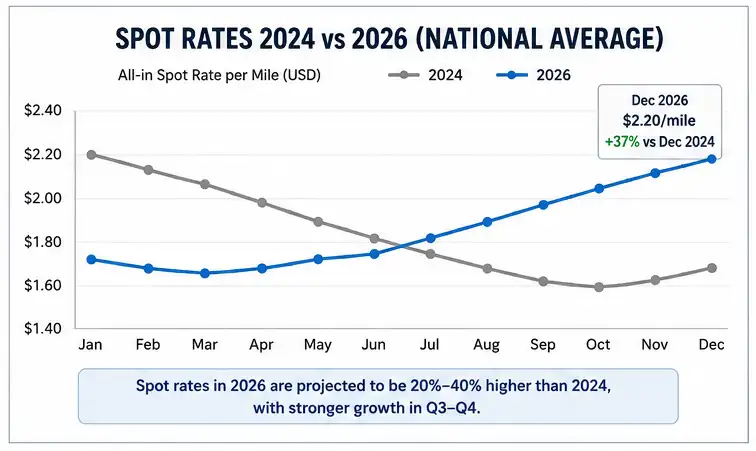
The fresh data backs that up. U.S. Bank and DAT said spot rates were up 31.29% year over year in May 2026, while contract rates were up 9%. Spot rates rose from $1.89 per mile in March to $1.95 in April and $2.14 in May, even as spot volumes slid from about 1.36 million to 1.11 million and contract volumes fell from roughly 852,000 to 739,000. That is not a classic demand boom. That is a market where pricing power is improving faster than shipment counts.
Cass shows the same thing from another angle. Its April 2026 shipments index was down 4.4% year over year, but the truckload linehaul index rose 5.6%. In May, Cass said the truckload linehaul index rose again to 150.8, up 6.9% year over year, and plainly said that volumes were beginning to recover but that supply constraints were doing most of the work in supporting higher rates.
So yes, spot rates 2026 are finally moving up. Yes, there is a freight market recovery story here. But a lot of that freight market recovery is supply-led before it is fully demand-led. That is why truck dispatch services matter more now, not less. When the market is messy, uneven, and fast, better paying loads do not go to the carrier who simply sees them. Better paying loads go to the carrier whose dispatch desk knows how to choose them.
What the 2026 data is actually saying in plain English
Here is the plain-English version. Freight is not exploding everywhere. But fewer trucks are available for the loads that need cover right now, and the trucks that stayed alive through the bad cycle do not have as much reason to say yes to weak freight. That is why spot rates 2026 are moving.
The U.S. Bank and DAT rates report published on April 1, 2026 already showed the shift starting. Spot rates averaged $2.01 per mile in February, up from $1.65 in November, while contract rates moved to $2.12 from $2.02. More importantly, the spread between contract and spot pricing shrank from about $0.39 a year earlier to about $0.11 per mile by March 2026. In simple words, the spot market stopped being the cheap market.
By late June, that move looked even more real. U.S. Bank and DAT showed May spot rates at $2.14 per mile, just four cents under the May contract rate of $2.18. That kind of compression changes broker behavior fast. It also changes what a dispatcher can ask for when a posted rate is stale.
The Logistics Managers’ Index shows the same tightening from another angle. In April 2026, transportation prices hit 95.0, transportation capacity fell to 28.4, and the spread between transportation prices and transportation capacity reached 66.6, the largest gap the index had ever recorded. In May 2026, transportation prices hit a record 96.0 while transportation capacity stayed in contraction at 31.7.
That is a big reason spot rates 2026 feel different from the fake-outs of 2025. Back in mid-2025, the same index was still describing transportation as basically stuck in a holding pattern, with capacity near expansion territory and transportation prices far below current 2026 extremes. DAT was still saying in September 2025 that a real bull-market pricing cycle was not expected until 2026.
In other words, the freight market recovery did not come out of nowhere. It took a long time. It got delayed. It stayed frustrating. Then it finally started showing up in the numbers. That is usually how trucking turns happen. They do not feel obvious at first. They feel selective, choppy, and easy to misread.
Why spot rates are finally moving up
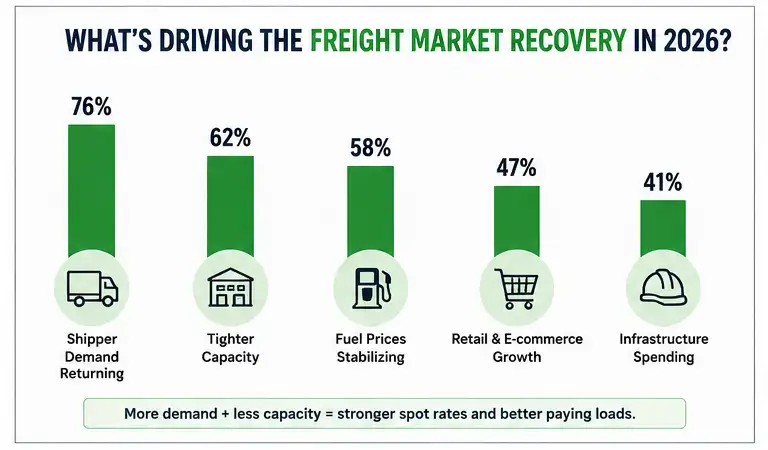
The first reason spot rates 2026 are moving up is simple: capacity got tighter.
The Bureau of Transportation Statistics said the Freight Transportation Services Index rose 0.3% in April from March and 1.4% from a year earlier, hitting 139.6, the highest point in the April 2023 to April 2026 series shown in that release. That is not a blowout volume story, but it is enough demand support to matter when capacity is already shrinking.
Census said the combined value of distributive trade sales and manufacturers’ shipments in April 2026 was up 1.2% month over month and 8.7% year over year. FreightWaves also reported in early June that the downturn of 2023 and 2024 had reversed, with industrial production rather than consumer spending leading the upcycle.
But the second reason matters just as much: carriers kept leaving or reallocating bad freight. DAT summed that up almost perfectly in March when it wrote that capacity was not gone, it had become selective. Its report said major fleets were steering trucks toward dedicated, specialized, and cross-border lanes instead of blindly chasing the spot board. That is a huge point for anyone talking about the freight market recovery. A carrier does not need the whole market to improve. It needs enough tight pockets to force better choices.
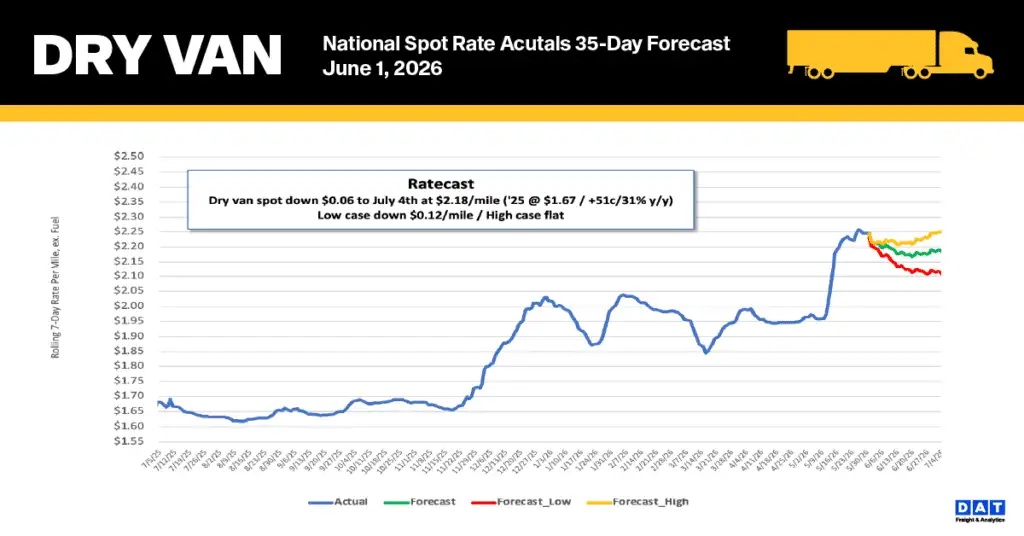
DAT’s dry van data kept reinforcing that message through spring. In mid-April, the national dry van linehaul average was $2.00, up 25% from a year earlier, and the dry van load-to-truck ratio was still more than double the long-term average for that week, with load posts 70% higher than the prior year. By early June, DAT said the national 7-day dry van linehaul average had climbed to $2.32, 39% above the same timeframe last year, while the dry van load-to-truck ratio rose to 18.53 and equipment availability remained well below long-term norms.
That is what many drivers miss when they hear freight market recovery and think it must mean huge national volume. Not necessarily. Sometimes the freight market recovery starts with carriers refusing weak freight, shrinking available trucks in the spot market, and forcing brokers to pay up for cleaner coverage. That is one reason spot rates 2026 are rising.
The third reason is that cost pressure is still real. The EIA said the U.S. average on-highway diesel price was $4.668 per gallon on June 29, 2026, which was still $0.941 above the year-earlier level even after a weekly drop. Back in April, DAT noted diesel had jumped sharply after Middle East disruptions and was still distorting all-in pricing. LMI also tied part of the recent transportation price spike directly to fuel and broader supply shocks.
Another reason is the number of drivers on the roads. Read more about recent changes affecting drivers in our article about Why Fewer Drivers on the Road Are Finally Pushing Freight Rates Up.
That matters because some of the freight market recovery is not free money. If a dispatcher sees spot rates 2026 moving up but ignores fuel, empty repositioning, tolls, and detention risk, the promised better-paying loads can disappear fast. Better-paying loads are only better when the truck keeps enough of the money.
Rates changes are affecting all truck type markets, including flatbed and hotshot markets. Learn more about hotshot market changes in our article How Freight Market Changes Affect Hotshot Truckers.
What a good dispatcher does with that window
Now we get to the part that actually matters to an owner-operator. If spot rates 2026 are better, what should a dispatcher actually do with that information?
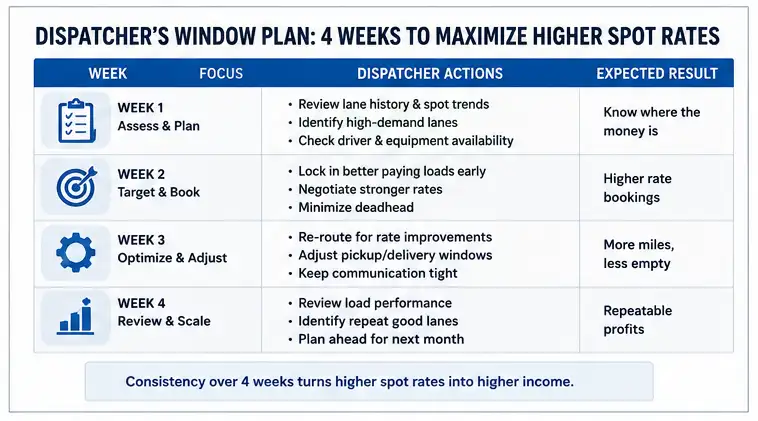
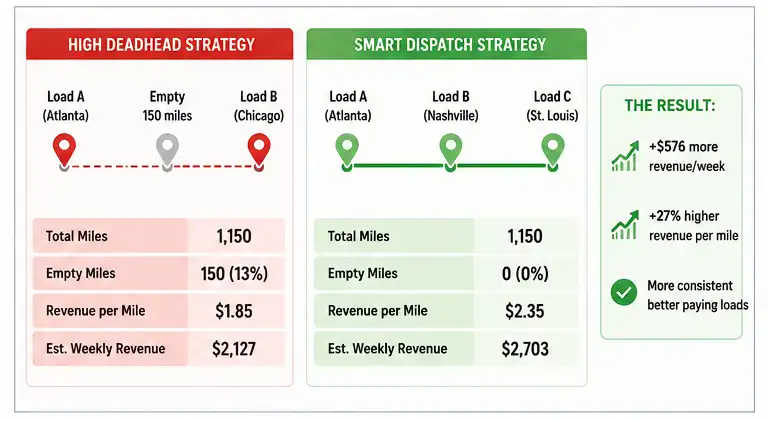
First, good truck dispatch services stop obsessing over the posted rate and start obsessing over the final week. This is the biggest difference between weak dispatch and strong dispatch. Weak dispatch books a load because the rate looks decent. Strong truck dispatch services ask five questions before they say yes. How far are the deadhead miles to pickup? What are the reload markets on the other end? How ugly is the appointment structure? What are the detention and layover terms? Does this broker create hassle after the rate confirmation is signed?
That is how better paying loads are really found. Not by staring at one number, but by protecting the truck’s next position.
Second, good truck dispatch services build lane memory. If your dispatcher does not know which areas still look strong when spot rates 2026 cool off for a week, you are working blind. Every experienced carrier knows some loads are headhaul money that drop you into a reload mess. Other loads are not flashy, but they place the truck into a market that books faster, reloads cleaner, and produces better paying loads on the second leg. Over a full week, the second kind often wins. That is lane selection in practice, not theory.
Third, good truck dispatch services push harder on timing than most drivers realize. When the freight market recovery is real but tight, better paying loads do not sit on the board long. A dispatcher who checks lanes after lunch is already late. The good desks have their short lists ready, know which brokers answer fast, and start working the next move before the current delivery happens. That is how the freight market recovery becomes usable instead of theoretical.
Fourth, good truck dispatch services get more selective with bad freight, not less. This part sounds backward to some drivers. When spot rates 2026 rise, should you take more loads? Sometimes yes, but not if the market is rewarding patience. In a tighter market, cheap freight gets even more dangerous because it can block better paying loads that are just thirty minutes away from posting. A smart dispatcher knows when to wait, when to counter, and when to walk.
Fifth, good truck dispatch services calculate all-in economics, not brochure economics. A 620-mile run at a high loaded-mile rate can still lose to a 650-mile run with less deadhead, better appointment timing, and a stronger outbound market. In this phase of the freight market recovery, dispatch skill is less about miracle negotiating and more about clean math.
That math matters even more because the spot-contract gap has narrowed so much. When spot rates 2026 push close to contract levels, brokers lose some of the easy excuses they used in weaker markets. That gives truck dispatch services more room to negotiate on rate, detention, truck ordered not used, and timing. But the dispatcher has to actually use that room. Better paying loads rarely arrive because a broker suddenly became generous.
Learn more about What Smart Dispatchers Are Doing Differently as Rates Start Improving.
A plain, usable dispatch playbook for owner-operators and small fleets
If I were setting a daily process for a one-truck operation or a small fleet inside this freight market recovery, it would look like this.
Start with the truck’s current position and likely next two reload zones. In a rising market, lane selection beats random hustle. Before you even touch fresh load postings, decide which outbound markets are worth protecting. If the truck is delivering into Chicago, Indianapolis, Columbus, Harrisburg, Dallas, Atlanta, or another known reload zone, do not throw away that position on a weak outbound unless the inbound paid enough to justify it. Spot rates 2026 reward clean positioning.
Then set a real floor, not a wish floor. Your dispatcher should know the minimum all-in number that still makes sense after fuel, deadhead miles, time risk, accessorial risk, and the quality of the next market. That floor should move by lane. During a freight market recovery, some markets deserve a premium because they protect the next day. Others deserve a discount because they create risk. A flat statewide rate target is lazy dispatch.
Next, rank loads in this order: net week value, reload strength, broker quality, then headline rate. The reason is simple. Better paying loads are often part of better weeks, not just better individual trips. A good dispatcher knows the difference.
Then pre-book the next step early. One of the easiest ways truck dispatch services create better paying loads is by reducing panic after delivery. When the next move is not lined up, brokers smell urgency. Urgency makes rates softer. When the next move is already being worked before the truck is empty, the dispatcher can negotiate from a stronger position.
After that, manage appointment friction like it costs money, because it does. During a freight market recovery, many carriers get fooled by stronger rates and forget how much unpaid time still destroys margin. A late-night live unload with a hard morning pickup can wreck hours of service, sleep, safety, and reload options. Good truck dispatch services treat bad appointments as a rate issue, not just an operations issue. If the timing is ugly, the money has to be better.
The same goes for detention. In a tighter market, truck dispatch services should be getting detention language confirmed before the truck rolls whenever possible. If a broker gets vague, price that uncertainty into the rate. Better paying loads are not just loads with a bigger linehaul number. Better paying loads are loads where the unpaid surprises are controlled.
One more point matters in spot rates 2026: do not confuse a hot load with a healthy lane. A single panic shipment can pay well and still leave the truck in the wrong place. A good dispatcher separates truly strong lane patterns from one-off broker desperation. When the freight market recovery is young, that distinction matters a lot.
A fair rule of thumb is this: never judge a load by the first leg only. Judge it by what it does to the next 24 to 48 hours. That single habit will save more deadhead miles than most fancy software.
Two realistic lane scenarios that show the real difference
Scenario one is a dry van owner-operator near Atlanta on a Thursday. The first posted option pays strong money into a weak rural market, but pickup is 95 empty miles away and delivery lands late Friday. The second option pays a little less on paper, but pickup is 22 miles away and it delivers into Indianapolis before noon, where reload markets are better. In a weak year, many carriers might gamble on the higher posted number because they need relief now. In this freight market recovery, a good dispatcher should prefer the second move unless the first one is paying enough to cover the ugly Friday and the likely weak reload. This is exactly how better paying loads get found: not by chasing the loudest number, but by protecting what happens after unload.
Scenario two is a small flatbed fleet with one truck unloading in Texas and a choice between a decent one-off run into a weak backhaul zone or a shorter move into the Midwest. That is consistent with DAT spring data showing Midwest and top-volume truckload lanes carrying durable premiums over the national average, while flatbed spring reports logged strong rate gains over several consecutive weeks. In that kind of market, truck dispatch services should think beyond the first invoice. A slightly shorter move into a better freight neighborhood can beat a longer first-leg payout once the next reload is counted.
These are not fantasy cases. They are the kind of choices drivers and dispatchers make every week. The difference is that weak dispatch sees one load. Strong truck dispatch services see a sequence. And in spot rates 2026, the sequence is where the money lives.
The hard truth for owner-operators right now
If you are an owner-operator reading this, here is the blunt version.
Do not assume the freight market recovery means you can stop being disciplined. Do not assume spot rates 2026 are high in every lane. Do not assume better paying loads will stay available if you wait too long. And do not assume truck dispatch services are all the same.
This market is finally offering more room for smart operators. That is good news. But the window belongs to the carriers who move on it correctly. The carrier who controls deadhead miles, protects reload markets, pushes back on weak offers, prices time risk correctly, and works with serious truck dispatch services has a real shot at turning this freight market recovery into cash flow instead of chaos.
That is where Dispatch Republic fits. From a dispatch desk point of view, truck dispatch services should do more than book the next load. They should help owner-operators read the market, protect the week, reduce empty miles, negotiate with data, and build calmer operations while spot rates 2026 are improving. The goal is not random motion. The goal is more control, fewer bad turns, and more better paying loads that actually hold up after fuel, timing, and deadhead are factored in.
If your truck is still running like it is 2024, this is the moment to fix that. The freight market recovery is giving disciplined carriers a small but real edge. Use it. Ask harder questions. Protect your reload markets. Work with truck dispatch services that understand lane selection, not just load booking. That is how spot rates 2026 become better paying loads instead of another missed window.
If you’re an owner-operator hauling specialized freight, don’t go it alone. Explore Dispatch Republic’s reefer truck dispatch services and power only dispatch services to access top-paying loads and compliance support. Check out our car hauling dispatch services and blog for more tips. Our dispatchers are experts in car hauling loads, flatbed loads, and reefer loads – we can match your truck to the best freight and handle the paperwork. Let us help you keep your rig loaded, safe, and legal.
For a deeper dive into the truck business, read our Box Truck vs. Dry Van: Which Is Better for Your Business? and Step Deck vs. Flatbed: Which Is Right for Your Fleet?
Ready to make the most of your trucking business? 🚚💨 Reach out to Dispatch Republic and let our experts help maximize your earnings with tailored hotshot dispatch service and box truck dispatch service solutions. We’ll handle the logistics while you keep on truckin’. Contact our truck dispatch service to get started on the road to greater profits and less hassle!
For more detailed guides, check Dispatch Republic’s resources on dispatching and the trucking business. How Much Can a Box Truck Owner Operator Earn if you’re weighing career paths, and How Professional Hotshot Dispatchers Find Better Loads Than Most Drivers to understand the dispatch side of the business.
If you’re an owner-operator juggling multiple responsibilities, consider partnering with a professional truck dispatch service to take the load off your shoulders—literally. At Dispatch Republic, we specialize in helping carriers run smarter and earn more by expertly managing load boards, negotiating top rates, and handling paperwork for dry vans dispatch service, reefers dispatch service, flatbeds dispatch service, box trucks dispatch service, step decks dispatch service, hotshots dispatch service and even car hauler dispatch services. Our team monitors multiple premium load boards around the clock, ensuring your truck stays loaded with the right freight, at the right rate, on the right lane. Whether you’re scaling up or just getting started, having a dedicated dispatch team in your corner means fewer empty miles, less stress, and more time to focus on driving and growing your business.
Frequently Asked Questions
Are spot rates 2026 really improving for owner-operators?
Yes. Spot rates 2026 have improved materially compared with late 2025 and early 2026, but the gains are uneven by lane and equipment type. U.S. Bank and DAT reported May 2026 spot rates at $2.14 per mile, up sharply year over year, while the gap between contract and spot pricing narrowed dramatically. That said, the freight market recovery is still selective, so owner-operators need lane discipline and strong truck dispatch services to turn stronger pricing into better paying loads.
Is the freight market recovery being driven by demand or by fewer trucks?
Mostly both, but right now the freight market recovery still looks more supply-led than broad demand-led. Cass said volumes were beginning to recover, but supply constraints were doing most of the work in pushing rates higher. DAT and LMI also showed tight capacity and strong price growth at the same time.
How do truck dispatch services help find better paying loads when the market starts turning?
The best truck dispatch services do not just search load boards. They compare lane history, deadhead miles, reload markets, delivery timing, detention risk, and broker behavior. That is how truck dispatch services turn a narrow freight market recovery into better paying loads instead of weak freight with a pretty posted rate. In short, truck dispatch services help carriers protect the week, not just the first leg.
Why do better paying loads still disappear even during a freight market recovery?
Because the better loads get covered first. When spot rates 2026 move up, brokers often still post low at first and then adjust based on how quickly trucks respond. Better paying loads may show for only a short time, especially in strong outbound markets. That is why truck dispatch services that work early, know lane selection, and pre-plan reload markets usually outperform carriers who only react after delivery.
What is the biggest mistake carriers make when spot rates 2026 improve?
The biggest mistake is confusing a higher linehaul number with a better business decision. In an early freight market recovery, a high-paying one-way move can still be a bad choice if it creates long deadhead miles, poor reload markets, or bad appointment timing. Better paying loads are the loads that improve the next move too. That is why experienced truck dispatch services judge the whole sequence, not just one rate confirmation.
Ready to Take Your Trucking Career to the Next Level?
Whether you’re an owner-operator, a company driver, or a carrier company in need of truck dispatch services, Dispatch Republic is here to help. Our team of experienced truck dispatchers offers affordable, professional truck dispatch solutions designed to save you time, increase your earnings, and make your business more efficient.
Thinking about outsourcing your truck dispatching? Contact Dispatch Republic today and move smarter, not harder.
Found our Blog useful? Spread the word:
Check our latest posts:

Contact us today to see how our team can support your trucking business.