

Table of contents
- Why brokers are screening harder in 2026
- What brokers now check before they say yes
- The ten mistakes that get carriers flagged fastest
- Sloppy setup packets
- Letting the MCS-150 go stale
- Insurance that does not match the job
- Unexplained phone and email changes
- Giving someone else practical control of your MC
- Booking more freight than your equipment can honestly cover
- Weak pickup discipline
- Poor tracking and slow check calls
- Bad delay handling
- Failing to act fast after identity theft or a false report
- What honest fleets should fix before the next broker setup
- How Dispatch Republic keeps carriers bookable when trouble starts
- The bottom line for 2026
- Frequently Asked Questions
You can run legal trucks, pay your insurance, answer your phone, and still hear the same line in 2026: “Sorry, our system will not let me use your carrier.”
That line usually does not come with much detail. You are not told which note hit you, which system flagged you, or why your MC suddenly went cold. You just stop getting booked. In today’s market, that often starts with paperwork issues, weak MC compliance, quiet load board blocks, or a handful of Highway red flags that never got fixed before the next booking. For honest fleets, that is one of the most frustrating parts of the business.
Brokers are screening harder because the losses are real. The 2025 report from the Transportation Intermediaries Association said truckload remained the mode most often hit by fraud, and 22% of respondents said they lost more than $200,000 to fraud in only six months. CargoNet then reported nearly $725 million in supply chain crime losses in 2025, with confirmed cargo theft up 18% and the average value per theft up 36%. Industry coverage of 2025 fraud data from Truckstop and Highway showed large volumes of blocked accounts, suspicious onboarding attempts, fraudulent emails, suspicious phone numbers, and unauthorized FMCSA contact changes.
From a dispatch desk, we see the same thing every week. Most honest carriers do not get frozen out because of one dramatic event. They get frozen out because paperwork issues pile up, MC compliance slips, load board blocks start to follow them, and Highway red flags never get explained. Then one broker adds a do-not-use note, another broker sees it, and the problem spreads. That is why this article matters. It is not about bad actors. It is about how good carriers accidentally look risky in a market that is already on edge.
The good news is that most of these problems can be prevented. Below, we break down the ten biggest mistakes that get carriers flagged by brokers in 2026, explain why they matter more now, and show how a strong dispatch team helps stop them before they cost you loads.
Why brokers are screening harder in 2026
The fraud wave changed broker behavior. TIA said unlawful brokerage, cargo theft, and identity spoofing remain widespread. Inbound Logistics, summarizing 2025 and early 2026 fraud data, said truckload freight remains the main target of fraud, and noted that organized theft has risen sharply since 2021. When that much money is disappearing, brokers stop giving the benefit of the doubt. They start looking for paperwork issues before they start looking for reasons to trust.
Platforms are tightening too. Truckstop-related reporting in 2025 said more than 12,700 suspicious onboarding attempts were blocked, almost 10,000 suspicious attempts were blocked from accessing the load board, and more than 70,000 entities were being monitored for suspicious or fraudulent activity. A January 2026 Truckstop report then said more than 63,000 entities were reviewed in 2025 to keep the load board safe. Highway’s Q2 and Q3 2025 data showed 495,267 fraudulent email attempts blocked in Q2, 42,421 suspicious phone numbers blocked in Q2, more than 605,000 fraudulent inbound emails blocked in Q3, 62,531 fraudulent phone numbers blocked in Q3, and 149 unauthorized FMCSA contact changes in Q3. That tells you why brokers react so fast to load board blocks and Highway red flags now.
Regulators are changing the front door too. The Federal Motor Carrier Safety Administration introduced identity verification for new registrants in April 2025 and says the process is designed to verify legitimacy, reduce fraud, enhance security, and protect sensitive data. FMCSA also stopped accepting paper payments after September 30, 2025, and warned that paper checks sent after that date would not be processed and could delay services. In 2026, the Motus registration system is opening wider for new and existing users, with more real-time validation and more digital controls.
FMCSA is also telling carriers to clean up who controls their files. On its Motus page, the agency says the listed company official should be the company owner or an employee responsible for managing FMCSA registration, not an outside consultant or transportation service provider. FMCSA also says records must be kept at the principal place of business, or be made available there within 48 hours on demand. Trucking Dive reported in February 2026 that FMCSA was restoring principal place of business enforcement as part of its anti-chameleon carrier push. That means MC compliance is no longer just a back-office chore. It is part of whether a broker believes your company is real, stable, and in control of its own authority.
State enforcement is part of this picture too. In its 2026 commercial vehicle safety plan, Indiana said investigators would prepare worksheets on suspected chameleon carriers and vet carriers before safety audit assignment. The same document also said added staff would help make sure paperwork is uploaded properly before audits move forward. That is a useful reminder: paperwork issues and MC compliance gaps are no longer treated as harmless small business chaos. Enforcement teams are reading them as risk markers, and brokers are doing the same.
The result is simple. Brokers now treat paperwork issues as risk signals. They treat MC compliance gaps as risk signals. They treat load board blocks as risk signals. And they treat Highway red flags as risk signals. Honest fleets feel that pressure because the net is catching bad actors and good carriers at the same time.
Handling temperature-sensitive freight introduces extra planning challenges. Many carriers rely on structured reefer dispatch services or consistent temperature-controlled dispatch to maintain tight timelines and prevent spoilage.
What brokers now check before they say yes
A lot of carriers still think a broker only checks whether the authority is active and the insurance is on file. That was never fully true, and in 2026 it is way off.
Brokers now compare several layers at once. They look at your carrier packet, your FMCSA file, your insurance details, your contact history, your safety profile, your pickup behavior, your tracking behavior, and any notes left in private systems. A carrier can pass one layer and fail the next. That is why paperwork issues that look small from the truck stop can become major booking problems on the broker side.
The first layer is identity and authority. FMCSA says its Licensing and Insurance system is the official record for whether an entity is authorized, and hard copies do not control whether the authority is active. FMCSA also says carriers can use the portal to file biennial updates, address changes, reinstatements, and other registration work. So if your packet says one thing and the federal file says another, the broker is usually going to trust the federal file. That is why paperwork issues and MC compliance problems so often show up together.
The second layer is reputation and do-not-use screening. Carrier411 says its do-not-use status can be tied to reliability, performance, behavior, compliance, safety, insurance, claims, or negative feedback. Carrier411 also added separate categories for identity theft, FMCSA data compromised, and people outside the United States or Canada. In plain English, a carrier does not need a federal shutdown to get flagged. Enough paperwork issues, enough MC compliance sloppiness, or enough Highway red flags can be enough to create broker blacklists inside private systems.
The third layer is identity behavior. Highway says sold MCs and ownership changes are often missed because the MC looks compliant on the surface even when the person using it is not the real operator. Highway listed warning signs such as dormant carriers that suddenly reactivate, insurance changes that do not fit prior patterns, contact changes that do not align with prior data, unfamiliar logins, and sudden urgency around payment or dispatch changes. Those are classic Highway red flags.
The fourth layer is live load behavior. DAT Freight & Analytics said in 2025 that brokers were using tools that flag carriers booking more loads than their available truck capacity, using jailbroken phones, using location emulators to fake GPS, logging in through international IPs, using IP masking, and relying on VOIP numbers. In other words, you can have active authority and still get hit with load board blocks if your behavior looks wrong at the track-and-trace level.
That is the big lesson many fleets miss. Brokers are not looking at just one screen anymore. They are matching your paperwork issues, your MC compliance, your load board blocks, and your Highway red flags across multiple systems at the same time.
The ten mistakes that get carriers flagged fastest
Most broker rejects in 2026 come from patterns, not one-off accidents. One missed document is not always fatal. One wrong phone number is not always fatal. But when paperwork issues stack on top of MC compliance drift, load board blocks, and Highway red flags, the carrier starts to look risky even if it is honest.
Sloppy setup packets
This is still the most common problem we see. The packet is missing a W-9. The certificate of insurance is old. The notice of assignment is blurry. The carrier packet uses one email address while the rate confirmation comes from another. The signed broker agreement comes back with blank sections. Brokers read that as poor control. In a fraud-heavy market, poor control quickly becomes risk. Paperwork issues are no longer a minor annoyance. They are often the first point where a good carrier gets slowed down or rejected.
A dispatcher prevents this by building one clean packet folder, naming every file the same way every time, checking dates before each setup, and sending only what the broker asked for. We also tell carriers not to send sensitive documents to random “urgent” emails. FMCSA posted fraud alerts in 2025 and 2026 about fake notices asking carriers to submit certificate of insurance, EIN verification letters, certificates of organization, and clear copies of driver licenses. That is how paperwork issues turn into identity theft.
Letting the MCS-150 go stale
An old MCS-150 tells brokers one thing: nobody is watching the file. In 2026, that is enough to create MC compliance doubts by itself. If the address, phone number, truck count, or officer information in your packet is newer than what FMCSA shows, many brokers will stop the onboarding until the federal record matches. That delay can cost the load.
Dispatchers should set a recurring review calendar for MC compliance, not just the biennial deadline. Review the office address, mailing address, phone numbers, email domains, trailer count, operation class, and safety contact before a broker asks. If those details stay clean, you cut down paperwork issues, reduce Highway red flags, and avoid a lot of quiet load board blocks before they ever happen.
Insurance that does not match the job
Many carrier rejections come down to insurance, but not always because the carrier has no insurance. The problem is usually mismatch. Cargo coverage is too low for the commodity. The filing has not hit the FMCSA system yet. The producer just changed. The VIN on a certificate looks strange. There is a cancellation notice in motion. Highway says insurance updates tied to a new producer or mismatched VINs are sold-MC warning signs brokers now watch. That means insurance paperwork issues can quickly become Highway red flags.
A strong dispatcher does more than ask whether there is insurance. We check the limit against the commodity, confirm the filing is live, and make sure the broker sees the same producer and contact data everywhere. That is real MC compliance work, and it keeps insurance questions from turning into load board blocks.
Unexplained phone and email changes
If your phone number changes three times in six months, your email domain is brand new, and your FMCSA record was recently edited, brokers get nervous. They are not overreacting. Highway reported 149 unauthorized FMCSA contact changes in Q3 2025. Carrier411 has a separate category for FMCSA data compromised and says scammers often change phone numbers and email addresses to impersonate legitimate carriers. Those are classic Highway red flags in 2026.
A dispatcher prevents this by keeping one approved phone tree and one approved contact list. When a change is real, we update the federal file first, then the broker packet, then the factoring company, then the load board profiles. We also call repeat brokers to explain major changes before they discover them on their own. That stops paperwork issues from becoming MC compliance concerns, and it helps lower the chance of load board blocks.
Giving someone else practical control of your MC
A lot of honest carriers do not mean to do this. They let a helper set up the company. They let someone outside the company handle the portal. They buy an authority package from a stranger. They sell the company but never fully shut down access. That is where real trouble starts. FMCSA says do not sell, buy, or lease a USDOT number or MC number outside a legitimate corporate transaction, and says it will inactivate the USDOT number and revoke related registrations if it finds that type of misuse. FMCSA also says the company official in Motus should be the owner or employee, not an outside consultant or service provider. That is pure MC compliance, and it matters.
This is also where one of the clearest real-world examples comes in. Highway described a sold-MC case where eight cargo theft claims were filed before the insurance provider reached the original MC owner, who had no idea his identity was still being used. That should make every owner-operator stop and think. If somebody else controls your access, paperwork issues are the least of your problems. You are one step away from Highway red flags, load board blocks, and an identity theft mess.
Booking more freight than your equipment can honestly cover
This one looks obvious, but it happens more than people think. A one-truck carrier accepts overlapping loads. A hotshot books freight that really needs a full-size trailer. A reefer books dry freight with no dry van backup. DAT said in 2025 that its fraud toolkit flags carriers booking more loads than truck capacity allows. That means sloppy operations can directly create Highway red flags and load board blocks, even if the carrier was only trying to hustle for more freight.
Dispatchers stop this by running a live capacity board. We know which truck is empty, what trailer it has, where it is, and whether it can legally make the pickup. That sounds basic, but it cuts down paperwork issues later too. Overbooked freight becomes late updates, revised documents, and broker frustration. That is how simple bad planning turns into MC compliance questions and load board blocks.
Weak pickup discipline
Fraud rings love confusion at pickup. England Logistics warned in 2026 that carriers should walk away if the broker listed on the rate confirmation differs from the one on the bill of lading, if someone asks the driver to check in under a different name or MC number, or if the pickup or delivery location on the load board differs from the paperwork. Those are major Highway red flags.
A dispatcher prevents this by making the pickup packet clean before the truck rolls. We verify the pickup number, the company name, the commodity, and the route. If anything changes, the driver does not “just run it.” We call the broker. We call the shipper. We document the answer. That kind of discipline keeps paperwork issues from becoming a stolen load, and it prevents the kind of incident that can lead to load board blocks across multiple broker systems.
Poor tracking and slow check calls
A lot of honest drivers hate extra tracking requests, but the market changed. The Women In Trucking Association noted in 2025 conference materials that criminals are using fake carriers, identity theft, and GPS jamming, and said the industry now relies on layered defenses such as GPS tracking, geofencing, secure parking, and standard operating procedures. DAT also says brokers are watching for location emulators and fake GPS updates. So when a carrier refuses tracking, misses check calls, or sends strange location data, brokers often read that as Highway red flags, not harmless delay.
A dispatch team can make this easier for drivers. We handle broker calls, explain delays before the broker has to chase the truck, and make sure the driver is not typing long updates while dealing with weather or traffic. If tracking fails, we tell the broker right away and switch to manual check calls. That kind of communication stops load board blocks that often grow out of simple silence.
Bad delay handling
Loads get delayed. That is normal. What gets carriers flagged is not the delay itself. It is what happens next. The driver goes quiet. Nobody updates the broker. The truck parks in an unsafe lot. The receiver closes. The paperwork gets messy. Then the whole load starts to look suspicious even though it began as weather or a breakdown. In a market full of fraud, silence creates Highway red flags fast.
This is where dispatch matters most. We adjust the route, document the cause of delay, call the broker, call the receiver, ask for a new ETA, re-book the next load if needed, and help the driver find safe parking or a safe stoppage point. That keeps paperwork issues under control, protects MC compliance, and prevents routine delays from turning into load board blocks.
Failing to act fast after identity theft or a false report
Some carriers get hit by fraud even though they did nothing wrong. The problem gets much worse when they move slowly. England Logistics warned that when a criminal steals your reputation and books freight under your MC, it can make it much harder to find new business because the MC is now tarnished. FMCSA’s fraud alerts also show that fake carrier-status notices, fake SAFER messages, fake action-required emails, and bogus compliance requests are active in the market. If you ignore those or respond late, the damage spreads.
A dispatch office should already have a response plan. Freeze risky contact changes. Audit the FMCSA file. Notify brokers you trust. Save every screenshot. Pull the current certificate, portal record, and insurance record. Ask what triggered any load board blocks. Then rebuild the packet with corrected data and a short explanation brokers can understand in one minute. Fast response will not fix every problem, but it gives honest fleets the best shot at protecting their MC compliance and removing false Highway red flags.
What honest fleets should fix before the next broker setup
If any of the mistakes above sound familiar, do not wait for the next rejection. Clean the file now.
Start with a document audit. Compare the packet against the FMCSA file line by line. Look for paperwork issues in names, addresses, phone numbers, email domains, cargo limits, authority status, and company official information. Then review the MC compliance basics: MCS-150 timing, insurance filings, principal place of business, and who still has access to the portal accounts. FMCSA says the company official should be an owner or employee, and records should be available at the principal place of business within 48 hours on demand. Those are easy things to ignore until a broker spots them.
Next, review the digital footprint. If you use VOIP numbers, call-forwarding tricks, shared inboxes, or foreign dispatch numbers without telling brokers, assume those can become Highway red flags. Carrier411 says some do-not-use reporting now captures whether personnel or operations are outside the United States or Canada. DAT says brokers are also watching for international IPs, IP masking, and VOIP numbers. That does not mean every outside contractor is fraud. It does mean the burden of clear explanation is much higher in 2026. Poor explanation often leads to load board blocks.
Then check authority and access control. FMCSA warns that USDOT numbers belong to the same legal person forever and may not be sold, transferred, rented, or leased. If you bought a company, changed ownership, changed officers, moved offices, or changed dispatch providers, make sure the record trail is clean. Hidden access is one of the fastest ways to create Highway red flags. A carrier that looks fine on paper can still get blocked if a broker thinks someone else is really operating behind the curtain.
Finally, ask direct questions about rejections. If you suspect load board blocks, ask whether the issue is packet related, insurance related, identity related, or performance related. Many carriers make the mistake of arguing before they know the reason. That only adds more negative notes. A dispatcher who knows how brokers think can often get more useful information than a frustrated cold call from the truck stop.
How Dispatch Republic keeps carriers bookable when trouble starts
This is where a dispatch company earns its keep. Anybody can call on a posted load. The harder job is keeping a carrier clean, trusted, and easy to book week after week.
At Dispatch Republic, we treat paperwork issues as an early warning system, not an afterthought. We review packets before setup, match them to what brokers usually ask for, and fix simple document errors before they become load board blocks. We treat MC compliance as a calendar item, not something to remember only when a broker asks. That means watching the MCS-150, the portal profile, the authority record, the company contact chain, and the insurance details.
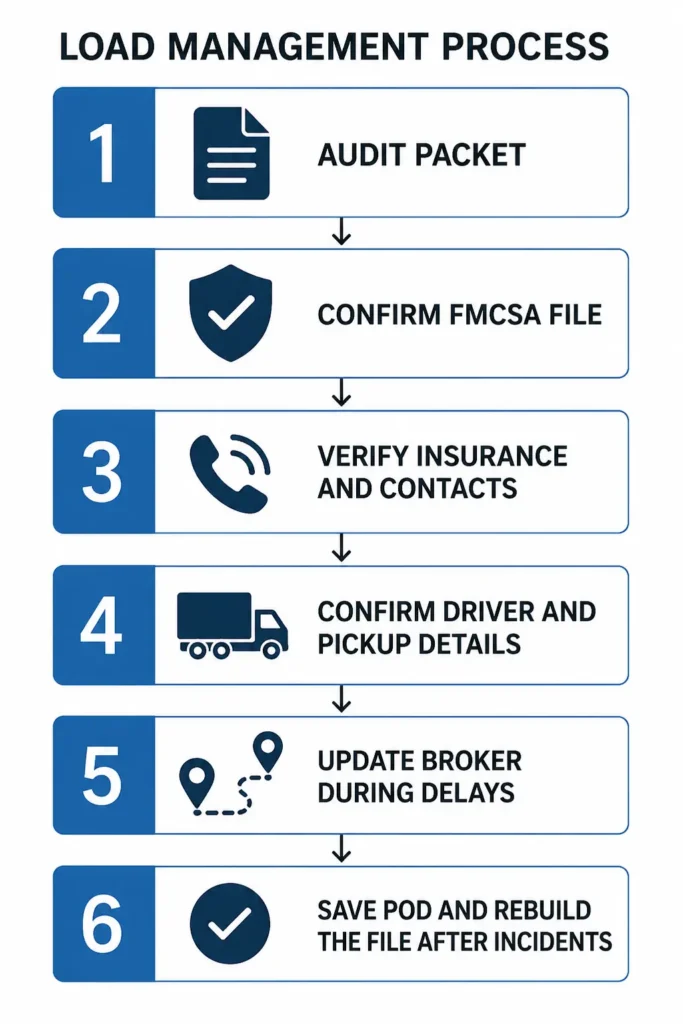
We also help carriers reduce Highway red flags before they become broker notes. If a phone number changes, we explain it. If a delay happens, we communicate it. If a route must change because of weather, road closure, or safety, we document it. If a driver needs to stop, we help find safe parking and tell the broker before the silence starts to look suspicious. That is one of the biggest real differences between a dispatcher and a simple load caller.
When a load breaks down mid-trip, dispatch support matters even more. We contact the shipper and broker, adjust the ETA, re-book the next load, handle the paperwork during delays, and keep the driver focused on the road instead of ten different phone calls. In a market full of fraud, a silent truck looks risky. A well-documented truck looks professional. That difference matters. It protects MC compliance, cuts down paperwork issues, and lowers the chance that one bad day becomes long-term load board blocks.
We also help when the problem is bigger than one load. If a carrier gets identity theft activity, suspicious FMCSA edits, or sudden load board blocks, we can help rebuild the packet, compare the federal file against the broker file, and create a short correction package that gives honest brokers a reason to take a second look. Not every block is reversible. But many are, especially when the problem is paperwork issues or MC compliance drift rather than actual fraud or unsafe operations.
Open deck freight involves more complex logistics due to cargo sizes and loading requirements. Many carriers find that structured flatbed dispatch services paired with reliable step deck dispatch services helps manage that complexity more effectively.
The larger point is simple. A good dispatcher is not just there to find freight. A good dispatcher protects the carrier’s booking reputation. That means fewer Highway red flags, fewer load board blocks, tighter MC compliance, and far fewer paperwork issues eating up the week.
The bottom line for 2026
Honest fleets are getting screened harder because fraud got bigger, smarter, and more expensive. That is not changing anytime soon. TIA, CargoNet, Truckstop, DAT, Highway, and FMCSA are all pointing in the same direction: more vetting, more identity controls, more scrutiny, and less tolerance for sloppy files.
So here is the practical takeaway. Clean up paperwork issues now. Tighten MC compliance now. Ask questions about load board blocks now. Treat Highway red flags like smoke, not noise. The carriers that stay bookable are usually not the loudest carriers. They are the cleanest carriers.
And if you are too busy driving to keep all of that straight, get help. A real dispatch team can protect your time, protect your reputation, and keep preventable mistakes from costing you good freight. That is exactly where Dispatch Republic comes in. We help carriers stay organized, stay compliant, communicate well under pressure, and keep moving when other fleets get stuck in setup delays, route changes, bad weather, or broker mistrust.
The freight still goes to carriers brokers trust. Make sure yours is one of them.
If you’re an owner-operator hauling specialized freight, don’t go it alone. Explore Dispatch Republic’s reefer truck dispatch services and flatbed and step deck dispatch services to access top-paying loads and compliance support. Check out our car hauling dispatch services and blog for more tips. Our dispatchers are experts in car hauling loads, flatbed loads, and reefer loads – we can match your truck to the best freight and handle the paperwork. Let us help you keep your rig loaded, safe, and legal.
For a deeper dive into the hotshot hauling business, read our Box Truck vs. Dry Van: Which Is Better for Your Business? and Step Deck vs. Flatbed: Which Is Right for Your Fleet?
Ready to make the most of your trucking business? 🚚💨 Reach out to Dispatch Republic and let our experts help maximize your earnings with tailored hotshot dispatch service and dry van dispatch service solutions. We’ll handle the logistics while you keep on truckin’. Contact our truck dispatch service to get started on the road to greater profits and less hassle!
For more detailed guides, check Dispatch Republic’s resources on dispatching and the trucking business. Recent FMCSA Rule Changes for Immigrant CDL Holders if you’re weighing career paths, and Hotshot Dispatch and Compliance: Key Regulations Every Dispatcher Should Know to understand the dispatch side of the business.
If you’re an owner-operator juggling multiple responsibilities, consider partnering with a professional truck dispatch service to take the load off your shoulders—literally. At Dispatch Republic, we specialize in helping carriers run smarter and earn more by expertly managing load boards, negotiating top rates, and handling paperwork for dry vans dispatch service, reefers dispatch service, flatbeds dispatch service, box trucks dispatch service, step decks dispatch service, hotshots dispatch service and even car hauler dispatch services. Our team monitors multiple premium load boards around the clock, ensuring your truck stays loaded with the right freight, at the right rate, on the right lane. Whether you’re scaling up or just getting started, having a dedicated dispatch team in your corner means fewer empty miles, less stress, and more time to focus on driving and growing your business.
Frequently Asked Questions
What paperwork issues get carriers flagged by brokers the fastest?
The fastest paperwork issues are usually missing W-9 forms, old insurance certificates, mismatched addresses, missing signatures, and setup packets that do not match the FMCSA file. In 2026, paperwork issues can also come from sending documents to fake FMCSA notices or using old authority PDFs instead of checking the live federal record. Brokers read repeated paperwork issues as a control problem, and that can lead to more Highway red flags and load board blocks.
How does MC compliance affect broker approvals in 2026?
MC compliance affects almost every booking decision now. Brokers look at whether the authority is active, whether the MCS-150 is current, whether the company official and contact details match, whether the insurance filing is live, and whether the principal place of business looks real. Weak MC compliance does not always mean a carrier is unsafe, but it does tell a broker the file may not be under control. In a fraud-heavy market, that often leads to a rejection.
What causes load board blocks for honest carriers?
Load board blocks can happen when a platform or broker sees suspicious behavior, even if the carrier is honest. Common causes include failed identity checks, mismatched contact data, too many loads booked for the equipment available, VOIP numbers, masked IPs, fake GPS signals, or negative performance notes. Truckstop and DAT both say they are blocking or flagging suspicious activity at scale, so honest carriers need clean packets, better MC compliance, and fewer Highway red flags to stay clear.
What are Highway red flags in carrier vetting?
Highway red flags are warning signs brokers see when identity, control, or load behavior does not look right. That could mean a dormant carrier suddenly reactivated, insurance changed in a strange way, contact information shifted, unfamiliar logins appeared, an unauthorized FMCSA contact change happened, or route and payment behavior suddenly changed. Highway red flags do not always prove fraud, but they do tell brokers to slow down or say no until the carrier explains the issue.
Can a dispatcher really prevent paperwork issues, MC compliance problems, load board blocks, and Highway red flags?
Yes. A good dispatcher standardizes packets, catches paperwork issues before setup, keeps MC compliance on a schedule, explains contact changes before brokers panic, handles broker communication during delays, and helps drivers avoid suspicious route changes or long silent gaps that create Highway red flags. Dispatchers also help carriers respond faster if load board blocks or identity theft problems appear, which can make recovery easier. That is one of the biggest reasons many small fleets use dispatch support in 2026.
Ready to Take Your Trucking Career to the Next Level?
Whether you’re an owner-operator, a company driver, or a carrier company in need of truck dispatch services, Dispatch Republic is here to help. Our team of experienced truck dispatchers offers affordable, professional truck dispatch solutions designed to save you time, increase your earnings, and make your business more efficient.
Thinking about outsourcing your truck dispatching? Contact Dispatch Republic today and move smarter, not harder.
Found our Blog useful? Spread the word:
Check our latest posts:


Contact us today to see how our team can support your trucking business.